- NATCA demands total overhaul of air navigation tools, NAMA deploys ADS-B, begins radar overhaul
- Inside the Air Peace, Ethiopian Airlines interline partnership
- Tourism: The road to Nigeria's global recognition, economic diversification
- Enugu Air/Omni-Blu set Dec 10 for London-Gatwick flights, tickets go live
- Tour operators unlock Nigeria's potential with new tourism passport



Tourism: The road to Nigeria’s global recognition, economic diversification
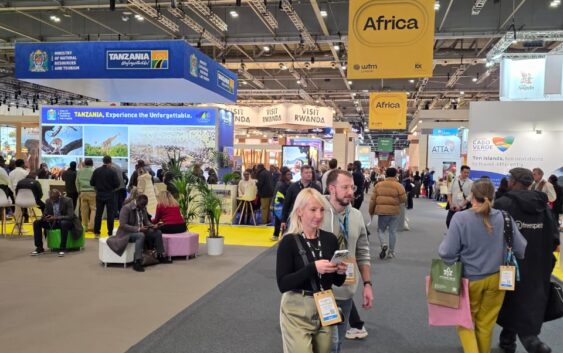
To unlock the economic goldmine of Nigeria’s tourism industry, one fundamental element must come to the fore: global visibility. Before the international community can recognise Nigeria as a serious tourism destination, the country must establish a consistent presence at major global platforms where nations aggressively showcase their cultural and destination potential, writes WOLE SHADARE, who was at this year’s World Travel Market (WTM) in London
Nigeria’s recent participation at the World Travel Market (WTM) London marks a strategic step in this direction.
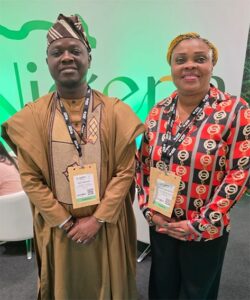 Awakan and Akporiaye
For three days, the Nigerian Pavilion transformed from a conventional trade stand into a captivating cultural hub. Spearheaded by the Nigerian Tourism Development Authority (NTDA), the nation made a high-profile return to the world’s premier travel trade show following endorsement from President Bola Ahmed Tinubu
Since assuming office, the Director-General of the Nigerian Tourism Development Authority, Mr Ola Awakan, has maintained a clear operational blueprint for leading the tourism sector: 30 per cent global visibility and 70 per cent domestic development.
This dual strategy aims to maintain a strong presence in major international travel markets to attract investors, development partners, and international tourists, while also developing local festivals, tourist destinations, and hospitality infrastructure at home.
Presidential support, national reconstitution
The path to WTM London was not without initial hurdles. At one point, Nigeria’s participation appeared doubtful. However, following a crucial meeting with President Bola Ahmed Tinubu, the President reaffirmed his complete support for the nation’s tourism agenda.
This intervention underscores the President’s commitment to sector development, reflecting a vision to replicate what Lagos State achieved nationally. Furthermore, participation at WTM London is not a one-off outing, but a sustained campaign that will expand to other major international travel markets.
For many Nigerians in the diaspora who previously felt unrepresented at these global events, the showcase provided a long-awaited platform they could proudly identify with.
Challenging perceptions
Engagements at the exhibition revealed significant international interest in Nigeria, alongside persistent misconceptions.
Negative perceptions have historically kept potential visitors away. Being present at international forums allows Nigeria to directly address these narratives and demonstrate its readiness for global tourism.
Nigeria held discussions with foreign companies, investors, and state representatives about potential partnerships, including cultural exchanges and media collaborations.
Several international media organisations indicated interest in visiting Nigeria to cover its cultural offerings.
At its core, changing Nigeria’s global image hinges on deliberate storytelling. Nigeria represents a rich microcosm of narratives that have historically lacked structured documentation and promotion.
To bridge this gap, plans are underway to launch Nitory, a dedicated tourism streaming platform designed to showcase Nigeria’s culture, heritage, and destinations to a global audience.
Through destination-focused films and compelling narratives, the platform will feature direct links to local tour operators, enabling international viewers to seamlessly organise travel to showcased locations.
A multi-stakeholder approach to infrastructure and safety
While government and security agencies continue working to address safety challenges, stakeholders across the sector are urged to focus on promoting Nigeria’s positive experiences.
Government action alone remains insufficient. Transforming the industry requires active participation from the private sector, the media, and key industry stakeholders.
Given the media’s agenda-setting role, strategic media engagements are vital to repositioning the country’s image.
Unlocking tourism’s true contribution to GDP
Tourism has evolved beyond recreation into a primary driver of national economic growth. Unlike finite natural resources that require extensive capital for exploration, extraction, and refining, tourism is an accessible economic resource that requires strategic investment.
Current statistics estimate tourism’s contribution to Nigeria’s GDP at between 4 and 5 per cent. However, this metric often misses the broader value chain. When accounting for transportation, hospitality, food services, and festival-related commerce, the sector’s total potential contribution is estimated at at least 25 per cent of GDP.
Nigeria has previously shown it can achieve global dominance when focused—most notably through the international rise of its music industry.
With intentional policy execution, private sector collaboration, and sustained global engagement, Nigeria’s tourism sector is positioned to achieve similar success.
At the centre of this push was Awakan, who personally engaged international travel media and trade partners.
“Nigeria’s participation provides an opportunity to showcase our tourism assets to a global audience, enhance the visibility of key destinations, and explore new market opportunities,” Awakan stated during the summit.
“We are leveraging this international platform to promote collaboration, innovation, and strategic storytelling to advance our tourism potential, drive GDP growth, and create vital jobs for Nigerian youths.”
The NTDA DG further stated that tourism has gone beyond being a sector associated with pleasure and recreation. It has become a major economic driver, adding that when he met with the President, he explained that what he achieved through tourism in Lagos could also be achieved at the national level, particularly now that he is President.
“The President’s economic diversification agenda can be significantly supported by tourism. Unlike oil, which requires substantial investment in exploration, extraction and refining, tourism is already a natural resource and an economic gold mine that we need to invest in.”
“If we properly harness all the subsectors and the entire tourism value chain, the contribution could be significantly higher. Transportation is part of tourism. Hospitality is part of tourism. Even the food people consume when they attend festivals and visit tourist destinations forms part of the tourism value chain”, he added.
A former President of the National Association of Nigerian Travel Agencies (NANTA), Mrs Susan Akporiaye, said Nigeria’s participation at the WTM has marked a historic turning point for the nation’s tourism sector, driven by unprecedented collaboration between the public and private sectors.
Speaking at the global event, Akporiaye expressed deep enthusiasm for Nigeria’s presentation, noting that, for the first time, an authentic and unified Nigerian identity was clearly reflected on the international stage.
“What makes it even more encouraging is the collaboration between the government and the private sector,” Akporiaye stated.
“The last time I witnessed this level of collaboration was during an event in Australia. I believe this is a positive development, and the efforts of both sectors should not be allowed to fail.”
She commended both the Minister of Tourism and the President for their deliberate commitment to working alongside private-sector operators through proper industry structures.
Last line
Nigeria’s presence at WTM London was not merely ceremonial; it served as a strategic statement of intent. Destinations ranging from the serene heights of Obudu and the wildlife-rich expanse of Yankari to the historical rhythms of Osun-Osogbo, Argungu, Lagos, and Calabar were placed front and centre before global buyers.
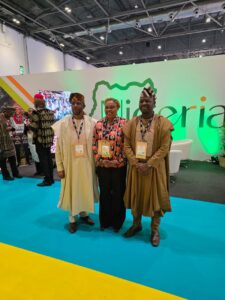
Travel agents showcased tour packages, simplified visa details, and presented emerging investment frontiers in Nigeria’s hospitality sector.
Google+