- NATCA demands total overhaul of air navigation tools, NAMA deploys ADS-B, begins radar overhaul
- Inside the Air Peace, Ethiopian Airlines interline partnership
- Tourism: The road to Nigeria's global recognition, economic diversification
- Enugu Air/Omni-Blu set Dec 10 for London-Gatwick flights, tickets go live
- Tour operators unlock Nigeria's potential with new tourism passport



NATCA demands total overhaul of air navigation tools, NAMA deploys ADS-B, begins radar overhaul
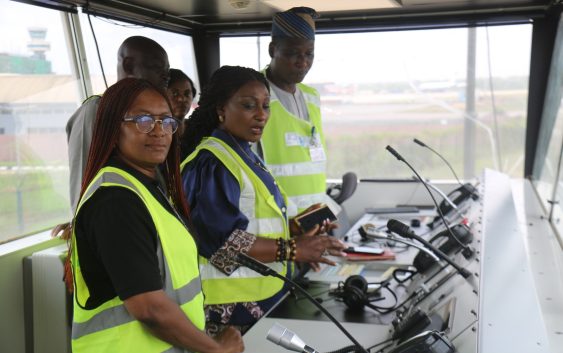
President of the Nigerian Air Traffic Controllers’ Association (NATCA), Edino Amos, has expressed concern over decrepit airspace infrastructure, stressing that the most critical flashpoint is infrastructural decay.
He noted that despite announced approvals and procurement milestones, communication and surveillance infrastructure remains plagued by severe shortcomings.


While welcoming regional and international delegates to the 55th Annual General Meeting (AGM) of the association themed “Beyond Silos to Synergy: Shaping the Future of Nigerian Air Traffic Management,” Amos did not mince words regarding the perilous state of the nation’s air navigation infrastructure, issuing a stern warning of a looming service withdrawal should the Federal Government fail to provide the facilities that would make their work seamless.
While acknowledging recent stakeholder engagements, including presentations to the Minister, the National Counter Terrorism Centre, the Office of the National Security Adviser, and NAMA management, as well as a memorandum to the National Assembly on aviation funding reform, Amos issued a grave warning.
“It is with a deep sense of responsibility that I state that this frustrating engagement is pushing the Association towards considering the withdrawal of our services, should there be no clear strategic plan for the total overhaul of communication and surveillance infrastructure in Nigeria. Minister of Aviation and Aerospace Development, we make this call not as a threat, but as patriots who sit daily before screens and failing frequencies to keep this country safe, to explore technical assistance in resolving persistent challenges affecting its communication equipment.”
Addressing institutional governance, Amos declared NATCA’s total support for the NATCA NCAT Chapter’s petition to the electoral committee of the ATS/Communications School. He stressed that the association will fiercely resist any arbitrary disruption of established protocols for appointing the Head of the Area/Airways Department.
Amos issued a collective rallying cry to NAMA management, engineers, regulators, the Ministry, and the National Assembly.
“We have come a long way, but we still have far to go. Let us continue to build, to engage, and to stand united,” he added.
The Managing Director of the Nigerian Airspace Management Agency (NAMA), Farouk Ahmed Umar, who responded to the controllers’ claim, disclosed that the agency has acquired Automatic Dependent Surveillance-Broadcast (ADS-B) equipment and commenced an overseas training programme for its personnel as part of efforts to modernise air traffic management and improve operational efficiency.
The NAMA MD disclosed this at the 55th Annual General Meeting and Conference of the Nigerian Air Traffic Controllers’ Association (NATCA) in Lagos with the theme: “Beyond Silos to Synergy: Shaping the Future of Nigerian Air Traffic Management,” which focused on the need for stronger collaboration between stakeholders to improve the safety, efficiency and sustainability of air traffic management in Nigeria.
Umar, represented by the Director of Air Traffic Services, Mr John Tayo, said the agency was also pursuing a comprehensive overhaul of its radar systems to address deficiencies in existing infrastructure and strengthen surveillance capabilities.
He said the agency was also pursuing a comprehensive overhaul of its radar systems to address deficiencies in existing infrastructure and strengthen surveillance capabilities.
On manpower development, the NAMA boss said the first batch of the agency’s overseas training programme had begun, with subsequent phases expected to give more personnel international exposure and access to global best practices in air traffic management.
Addressing the core premise of the AGM, Amos emphasised that air traffic management is a delicate “system of systems.”
“When these parts operate in isolation, the consequences are felt most acutely by the controller at the console: when a frequency fails, when harmattan conditions disrupt operations at Kano and Abuja, or when surveillance is lost along the Lagos–Abuja corridor,” Amos stated.

Highlighting human capital development as the heartbeat of NATCA’s strategic plan, Amos reported significant milestones, noting that over 100 controllers are undergoing training at the Nigerian College of Aviation Technology (NCAT), Zaria, and the Nigerian Air Force Air Traffic Services Training Centre, with recent graduates now licensed and ready for the ATC family, building on last year’s landmark Fatigue Risk Management training by United ATS which contributed to Nigeria scoring an impressive 91.45% Effective Implementation score at the April 2026 ICAO Coordinated Validation Mission United ATS is set to train another 60 controllers in Air Traffic Flow Management in Lagos.
