- FAAN MD: Financing talks for Lagos airport rail extension reach advanced stage
- Riding the Tidal Wave: How CITA Energies navigated 20 years of jet fuel volatility
- Delta unveils major upgrade to Delta One, redefines premium long-haul travel
- NSIB opens probe into Challenger 604 door separation incident
- Private jet forced into emergency landing in Abuja after door detaches



Expert debunks 11m Passenger figure
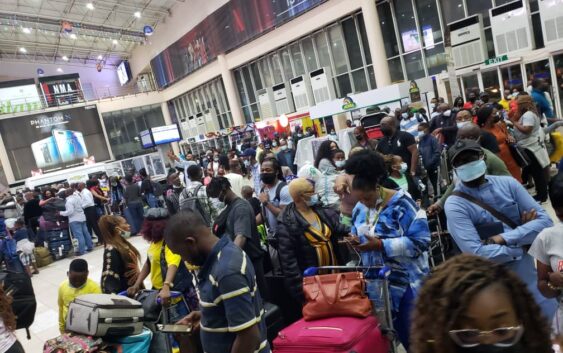
…Urges FG to redefine 5% TSC to save aviation sector
The Nigerian travel market risks immediate and severe suppression if airfares rise by even a single dollar, a situation poised to worsen if the government presses forward with plans to reintroduce Value Added Tax (VAT) on domestic tickets.

This warning was sounded by Roland Iyayi, the President/CEO of Top Brass Aviation Limited and former Managing Director of the Nigerian Airspace Management Agency (NAMA), while speaking with Aviation Metric at the weekend.

Iyayi also debunked the widely circulated industry figure of 11 million annual passengers, exposing it as a deception.
Instead, he revealed that the industry has suffered a steady 10% year-on-year decline in passenger traffic since 2021.
Ultimately, this traffic drop highlights a market reacting violently to pricing structural shocks. Without a deliberate overhaul of the fiscal framework, such as shifting the 5% Ticket Sales Charge (TSC) into a dedicated, ring-fenced Aviation Development Fund to address the country’s multi-billion-dollar infrastructure deficit, operators are left managing dwindling load factors in a hyper-inflationary environment.
As a trustee of the Airline Operators of Nigeria (AON), Iyayi has consistently argued that domestic airlines are fundamentally overburdened.
He pointed to a crushing stack of roughly 17 different taxes, fees, and charges levied per flight.
A major point of contention remains the 5% TSC collected by the Nigerian Civil Aviation Authority (NCAA), which he argued severely limits domestic airlines’ ability to remain profitable or to unbundle tickets to offer true low-cost options.
Furthermore, Iyayi threw his weight behind a proposed move by the National Assembly to redistribute the 5% TSC and Cargo Sales Charge (CSC) sharing formula.
He criticised the current breakdown as heavily and arbitrarily skewed in favour of the NCAA, which receives 58%, leaving operational and capital-heavy agencies like NAMA financially starved.
“While the NCAA acts as a regulatory office, NAMA bears the massive financial burden of purchasing, maintaining, and powering airspace calibration equipment, radar systems, and navigational aids across the entire country,” Iyayi stated.
Speaking on the excess charges levied against airlines and passengers, Iyayi dismissed the government’s justification that passengers, not airlines, bear the brunt of these costs.
“While we were still shouting that there are 11 million passengers, the argument from the government was that the passengers are the ones paying,” Iyayi said. “But who provides the capacity for the passengers to travel? Is it the government? The capacity is provided by private entrepreneurs, so it is a cost to them. If you suppress demand, who takes a loss? Is it the government? If the airline starts failing simply because of some policy you have introduced that doesn’t make any sense, what’s the benefit to the country?”
He urged the government to consider the macroeconomic benefits and multiplier effects that a well-funded, properly structured aviation sector could generate.
Recalling a past encounter regarding the introduction of VAT on ticket sales, Iyayi noted: “We went to the then Minister of Finance and said, ‘Look, if you do this, you will kill the local industry.’
He said, ‘No, you have all these million passengers. This is how much money we can make.’ We told him if you have all that money coming in, that’s fine, but I can guarantee you something: the moment you increase a ticket price by one dollar, you will suppress demand.”
He added that policymakers fail to grasp a simple economic reality: “When you have adequate infrastructure within your system, your traffic flow will increase. When your traffic flow increases with aeroplanes and passengers, both international and domestic, you will naturally earn more money.”
Iyayi’s argument regarding the revenue remittances of agencies such as the Federal Airports Authority of Nigeria (FAAN) and the NCAA targets a foundational flaw in Nigeria’s aviation fiscal structure.
His characterisation of the NCAA as one of the top contributors to the Federal Government’s Consolidated Revenue Fund (CRF) highlights just how heavily the state relies on aviation levies to fund the national budget.
According to figures cited by Iyayi, the NCAA remitted over $500 million to the government’s coffers in 2023, followed by another $496.3 million in 2024.

“When an agency tasked purely with safety oversight is generating and remitting roughly half a billion dollars annually to the central government, it shifts the agency’s identity from an industry enabler to an aggressive revenue collector,” Iyayi added.
Google+