- FAAN MD: Financing talks for Lagos airport rail extension reach advanced stage
- Riding the Tidal Wave: How CITA Energies navigated 20 years of jet fuel volatility
- Delta unveils major upgrade to Delta One, redefines premium long-haul travel
- NSIB opens probe into Challenger 604 door separation incident
- Private jet forced into emergency landing in Abuja after door detaches



FAAN MD: Financing talks for Lagos airport rail extension reach advanced stage
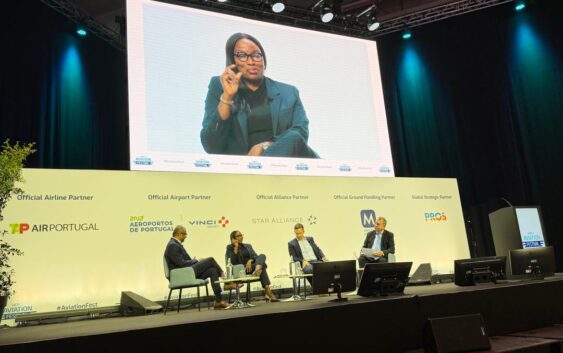
Efforts to integrate Murtala Muhammed International Airport (MMIA) into the Lagos Mass Transit Red Line rail network have gained significant traction, with financing discussions now at an advanced stage, according to the Federal Airports Authority of Nigeria (FAAN).


FAAN’s Managing Director and Chief Executive Officer, Mrs Olubunmi Kuku, disclosed this while serving as a keynote panellist at the World Aviation Festival in Lisbon, Portugal, held under the theme ‘Defining the Airport of the Future — Technology, Partnerships, and People.’
The project, a joint initiative between the Federal Government, FAAN, and the Lagos State Government, seeks to build a dedicated rail line connecting all three airport terminals to the broader Red Line system.
The link forms a critical component of the ongoing MMIA modernisation project designed to revolutionise passenger connectivity to and from Nigeria’s busiest aviation hub.
On the project’s structure, Kuku said funding arrangements are nearing completion.
“We are actually working on completing the financing of the capital structure for that project,” Kuku said. “What it does is it allows us to connect the city very quickly to the airport, with five stops within our airport ecosystem. It connects our passenger terminals and links our cargo facilities right to the final stop.”
She emphasised that the intermodal integration relies on strong inter-governmental collaboration between federal and state authorities to optimise urban transit.
On wider infrastructure upgrades at MMIA, the FAAN chief said the primary international terminal is undergoing a comprehensive overhaul to boost operational efficiency and passenger convenience through modern technology.
She pointed out that despite MMIA’s central role in the nation’s aviation sector, the facility had lacked major structural upgrades since its construction.
“That particular airport accounts for 68% of all air traffic in Nigeria, followed by Abuja with about 3 million passengers, and then Kano. Together, three airports account for 80% of our traffic, though I still manage 19 other airports and support five more that require strategic priority,” she explained.
Kuku added that given security and economic considerations, air travel has increasingly become a preferred and safer mode of transport in Nigeria, necessitating strategic resource allocation.
Outlining FAAN’s investment framework, Kuku stressed that safety and airside operations remain top priorities across the nation’s airport network.
“For me, it has been threefold. The first is a clear criterion focused on safety, which is why a large portion of our capital investment targets airside activities to keep basic operations functional,” Kuku noted. “Over the past three years, our focus has been on rehabilitating major primary international airports.”
Nigeria currently operates six international gateways: Lagos, Abuja, Port Harcourt, Kano, Enugu, and Maiduguri.
Infrastructure projects currently underway include complete runway resurfacing, runway extensions where feasible at select airports, and the installation of modern Airfield Lighting Systems (AFLS).
For Lagos specifically, Kuku clarified that Terminal 1 is undergoing an internal overhaul rather than a physical footprint expansion.
“For Lagos, being our flagship airport, Terminal 1 is being completely gutted and redesigned internally. We aren’t expanding the building’s footprint, but we are making it substantially more efficient,” Kuku added. “We are reconfiguring the layout for Immigration and Customs, increasing processing counters, and integrating modern technology to deliver a seamless passenger experience.”
Google+

[…] to its airport, and said efforts were underway to modernise the rail system in Lagos, with FAAN working to complete the financing structure for a dedicated rail line connecting all three terminals of Murtala Muhammed International Airport […]