- How mountain of debt is ‘grounding’ Nigeria’s aviation
- Lagos light rail to connect MMIA directly to Marina, city center, FAAN, CCECC mark landside concrete work completion
- IATA urges global support for CORSIA as aviation carbon scheme hits 10-year mark
- Etihad Airways, Ibom Air ink interline deal connecting Nigeria, Etihad's network
- 67 Years in the Sky: Sanusi Lauds AMCON, urges FG to protect Aero Contractors as "National Treasure"



Beyond Revenue Sharing: Why Nigeria Must Strengthen NAMA’s Funding for Safer Skies

The debate over the proposed review of the sharing formula for the five per cent Ticket Sales Charge (TSC) among aviation agencies has sparked passionate arguments across Nigeria’s aviation industry.

While every institution understandably seeks to protect its statutory sources of funding, the conversation ought to rise above institutional interests and focus instead on a more fundamental national question: what level of investment is required to guarantee the continued safety, efficiency and global competitiveness of Nigeria’s airspace?
This is the prism through which the proposal to increase the Nigerian Airspace Management Agency’s (NAMA) share of the Ticket Sales Charge from the current 23 per cent to 60 per cent should be examined.
Far from being a struggle for institutional advantage, the proposal reflects the realities confronting modern Air Navigation Service Providers (ANSPs) worldwide. Aviation has evolved into one of the most technology-driven industries on earth.
Consequently, the agencies responsible for managing national airspace now operate some of the most sophisticated and capital-intensive infrastructure in government. Every advancement in aircraft technology inevitably demands corresponding investment in the systems that guide, separate and protect aircraft from departure to arrival.
That responsibility in Nigeria rests squarely on NAMA
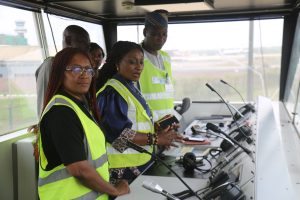
Every commercial flight that departs or lands within Nigerian airspace depends on an invisible but highly sophisticated network of communication, navigation and surveillance systems managed by the agency. Long before passengers board an aircraft, NAMA’s infrastructure is already at work—supporting flight planning, coordinating aircraft movement, monitoring airspace, maintaining communications between pilots and controllers, and ensuring that aircraft remain safely separated throughout their journey.
This work is largely unseen by the travelling public, yet it represents one of the most critical pillars of aviation safety.
Unlike many government institutions whose expenditures are largely administrative, NAMA operates a technology-intensive environment that demands continuous investment. Air navigation equipment is not installed once and forgotten.
Navigation systems age rapidly. Software platforms require regular upgrades. Surveillance systems must continuously evolve to meet emerging international standards. Communication infrastructure requires constant maintenance.
Equipment failures are not mere operational inconveniences; they carry direct implications for safety, efficiency and international confidence in Nigeria’s aviation system.
For this reason, ANSPs worldwide are among the most capital-intensive aviation institutions.
The financial realities confronting NAMA today bear little resemblance to those existing when the present revenue-sharing formula was conceived. Since then, aviation technology has advanced dramatically.
Satellite-based navigation, digital communications, surveillance technologies, automation systems, cybersecurity requirements and performance-based navigation have transformed global air traffic management. Keeping pace with these developments is no longer optional.
It is a fundamental requirement imposed by the International Civil Aviation Organisation (ICAO) and expected by airlines operating within international airspace.
Every delay in modernising critical infrastructure widens the technological gap between Nigeria and the world’s leading aviation systems.
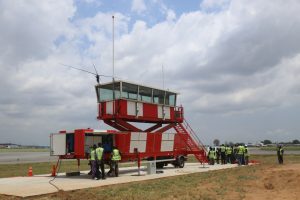
Perhaps nowhere is this challenge more evident than in the agency’s responsibility for maintaining Communication, Navigation and Surveillance (CNS) facilities across the federation.
These installations are dispersed nationwide, often in remote locations where access is difficult and public utilities are unreliable.
Instrument Landing Systems (ILS), Doppler Very High Frequency Omnidirectional Range (DVOR), Distance Measuring Equipment (DME), radar installations, Automatic Dependent Surveillance-Broadcast (ADS-B) facilities, Very High Frequency (VHF) communication stations and other critical navigation infrastructure require continuous technical maintenance to remain serviceable.
Maintaining these facilities comes at an enormous cost
One of the least appreciated realities is that a significant proportion of NAMA’s critical installations rely on diesel-powered generators due to the country’s persistent electricity challenges. Air navigation systems cannot simply be switched off whenever public electricity fails.
They must remain operational around the clock because aircraft continue to fly irrespective of power outages. Consequently, the agency expends enormous financial resources every year on diesel procurement, generator maintenance, and the provision of an uninterrupted power supply for facilities whose continuous operation is indispensable to flight safety.
This operational burden is unique
No aircraft can safely navigate Nigerian airspace without dependable navigation and communication infrastructure. Safety cannot be paused because electricity has failed.
Equally expensive is the statutory requirement to regularly calibrate navigational aids nationwide. International aviation standards require Instrument Landing Systems and other navigation facilities to undergo periodic flight calibration to verify their accuracy and reliability. These exercises involve specialised calibration aircraft, highly trained technical personnel and significant operational expenditure.
Yet calibration is not discretionary; it is a mandatory safety requirement. An uncalibrated navigational aid compromises operational integrity and may ultimately affect flight safety. These recurrent obligations alone consume substantial financial resources
Beyond infrastructure lies another equally demanding responsibility—human capital
Modern air navigation services depend on highly specialised professionals whose expertise takes years to develop. Air Traffic Controllers, Air Traffic Safety Electronics Personnel (ATSEPs), communication engineers, surveillance specialists, and other technical personnel operate in an environment where technological competence must be continually updated. As aviation systems become increasingly sophisticated, training cannot remain static.
NAMA therefore invests heavily in recurrent technical training both within Nigeria and abroad.
These programmes are conducted at internationally accredited institutions and often require substantial foreign-exchange commitments. Failure to sustain this investment would inevitably weaken technical competence. And in aviation, declining technical competence invariably translates into declining safety margins.
Infrastructure that previously cost millions now requires several times that amount. Spare parts, electronic components and manufacturer support services are largely imported and priced in foreign currencies. Yet NAMA’s statutory share of the Ticket Sales Charge has remained virtually unchanged despite these realities.
Against this background, the proposal to increase NAMA’s share of the Ticket Sales Charge to 40 per cent deserves objective consideration.
It is important to emphasise that this argument is not premised on diminishing the importance of any other aviation agency.
Every institution within Nigeria’s aviation architecture performs indispensable responsibilities. Effective regulation, accident investigation, meteorological services, airport management and air navigation are complementary—not competing—functions. Aviation safety is strongest when every agency is adequately resourced.
However, equitable funding should also reflect the capital intensity and operational demands of each institution.
NAMA is not merely an administrative agency. It is Nigeria’s Air Navigation Service Provider. It operates and maintains infrastructure that must function every minute of every day, in every weather condition, across one of Africa’s largest airspaces.
It manages systems that directly prevent aircraft collisions, facilitate safe take-offs and landings, provide continuous surveillance of aircraft movements and ensure orderly traffic flow throughout Nigerian airspace.
These responsibilities require sustained technological investment rather than episodic funding interventions. An increase to 40 per cent would, therefore, represent a strategic investment in national infrastructure.
Additional resources would enable the accelerated replacement of ageing navigation facilities, the expansion of surveillance coverage, the deployment of next-generation air traffic management technologies, enhanced redundancy for critical systems, improved power resilience, increased calibration capacity, strengthened cybersecurity, and greater investment in the recruitment, training, and retention of highly specialised technical personnel.
The benefits would extend far beyond NAMA itself
Airlines would experience greater operational efficiency. Flight delays arising from infrastructure limitations would be reduced. Fuel consumption associated with inefficient routing would decline. Passenger confidence would increase.
Nigeria’s attractiveness as a regional aviation hub would improve. International operators would continue to view Nigerian airspace as safe, reliable and technologically credible.
More importantly, millions of Nigerians who travel by air each year would benefit from a stronger, more resilient and future-ready air navigation system.
Ultimately, this conversation should not be reduced to percentages. It is about determining whether Nigeria wishes to build an air navigation system capable of supporting the country’s growing aviation ambitions over the coming decades.
It is about recognising that the cost of maintaining safe skies has changed fundamentally, and that funding mechanisms must evolve accordingly.
If Nigeria genuinely seeks to consolidate its position as Africa’s leading aviation hub, then strengthening the financial capacity of the institution responsible for managing the nation’s entire airspace is not simply desirable; it is imperative.
The proposed increase in NAMA’s share of the 5 per cent Ticket Sales Charge from 23 per cent to 40 per cent should therefore be viewed not as an institutional concession but as a strategic national investment in safer skies, stronger infrastructure, enhanced operational efficiency, and a more globally competitive aviation sector.
Google+