- Transport Summit Holds Friday
- What Abuja private jet door blowout reveals about aviation safety
- Jet fuel price volatility threatens supply companies' viability, warns CITA Energies Chief
- FAAN MD: Financing talks for Lagos airport rail extension reach advanced stage
- Riding the Tidal Wave: How CITA Energies navigated 20 years of jet fuel volatility



What Abuja private jet door blowout reveals about aviation safety
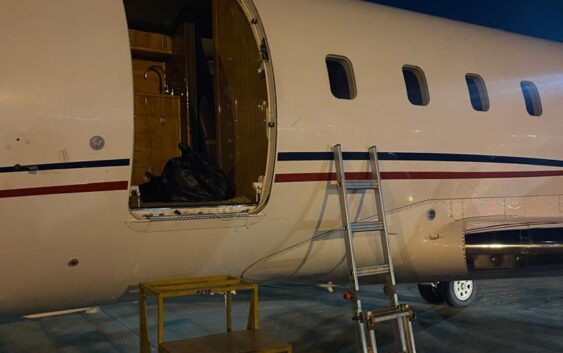
When a main exit door detached from a private jet climbing out of Nnamdi Azikiwe International Airport, Abuja, it brought a terrifying reality back to the forefront of civil aviation: at high altitude, a structural breach is an instantaneous crisis, WOLE SHADARE writes
At 16,000 feet, the sky offers no second chances. Outside a commercial airliner, the atmosphere is a freezing, oxygen-deprived void, a brutal environment held at bay only by aluminium skin, composite carbon fibre, and a complex network of pressurised structural seals.

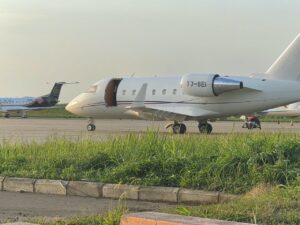
When that barrier fails, the transition from serene cruising to violent catastrophe happens in a fraction of a second.
The drama surrounding aircraft safety was thrust into sharp focus when a private jet climbing out of the Nnamdi Azikiwe International Airport in Abuja suffered a sudden, terrifying structural failure. Minutes into its flight, the main cabin exit door detached completely mid-air.
The crew fought against decompression and severe aerodynamic forces to bring the aircraft back down safely, landing in Abuja without fatalities while the rogue door plunged to earth and was eventually recovered by local farmers on the capital’s agricultural periphery.
As aviation regulators and investigators gather initial evidence for their official report, the Abuja emergency serves as a grim reminder that door detachments, though rare, rank among the most alarming mechanical failures in aviation history.
Understanding how a door detaches mid-flight requires examining a cross-section of mechanical engineering failures, maintenance oversights, and manufacturing flaws that have plagued civil aviation for decades.
Physics of a mid-air blowout
To grasp the sheer force of a door separation, one must understand cabin pressurisation. Commercial aircraft fly at high altitudes where ambient air pressure is insufficient to sustain human life.
To compensate, compressors pump air into the cabin, creating an artificial environment equivalent to roughly 6,000 to 8,000 feet.
This creates a massive pressure differential. The air inside the aircraft constantly tries to push its way out.
Modern airliner doors are typically designed as plug doors. Slightly larger than the door frame, they wedge tightly into the fuselage as cabin pressure increases, using the air pressure itself to keep the door sealed.
However, when latch mechanisms, hinge pins, lock indicators, or manufacturing bolts fail, that same internal pressure instantly converts the door into a high-powered projectile.
The sudden loss of pressure triggers explosive or rapid decompression, sweeping loose objects and unbelted passengers toward the opening.
Civil aviation history includes several watershed moments when doors or fuselage access panels detached mid-flight, driving fundamental changes in aircraft design, maintenance protocols, and safety oversight.
United Airlines Flight 811 (1989)
On February 24, 1989, a Boeing 747-122 departing Honolulu, Hawaii, experienced a catastrophic cargo door failure at 22,000 feet.
Short-circuiting electrical wiring caused the forward lower cargo door latch mechanism to unlock mid-flight. The differential pressure blew the door off the fuselage, tearing away a massive section of the passenger cabin floor. Nine passengers were lost.
The incident forced global regulatory changes to outward-opening cargo doors, leading to redesigned locking mechanisms, mechanical backup locks, and improved wiring-safety standards.
British Airways Flight 5390 (1990)
In June 1990, a BAC One-11 flying over England suffered a cockpit windscreen detachment at 17,300 feet. Although it wasn’t a passenger door, the principle was the same: an outward-mounted panel failed under pressure. The blow-out sucked the aircraft commander halfway out of the cockpit window; crew members held onto his legs while the co-pilot executed an emergency descent.
The investigation revealed that during the previous night’s maintenance, technicians had installed undersized bolts on the windscreen frame. The incident highlighted human factors in maintenance and led to strict dual-signoff procedures for critical flight hardware.
Alaska Airlines Flight 1282 (2024)
Perhaps the most alarming modern parallel to the Abuja incident occurred on January 5, 2024. A nearly brand-new Boeing 737 MAX 9 experienced a mid-air door plug blowout shortly after departing Portland, Oregon.
As the aircraft climbed past 16,000 feet, a door plug sealing an unused emergency exit door frame separated from the airframe, causing an immediate decompression.
The U.S. National Transportation Safety Board’s (NTSB) preliminary and final investigative reports uncovered a shocking reality: four crucial retaining bolts designed to prevent the door plug from sliding upward out of its tracks were missing when the jet left the manufacturing facility.
What experts look for
As the Nigerian Safety Investigation Bureau (NSIB) examine the Abuja private jet incident, investigators will follow a disciplined, methodical protocol. Aircraft accident investigations leave little room for guesswork.
Critical questions for the safety board
Was it mechanical fatigue or human error? Did latching pins fracture from cyclic fatigue as the airframe repeatedly expanded and contracted over thousands of flights? Or was the door improperly latched before taxi and takeoff due to a faulty warning sensor or crew oversight?
Did a pressurisation warning precede the event? In several historical incidents, aircraft showed minor pressurisation warning lights on flights before a major failure. Investigators will check whether the aircraft reported door-seal leaks or pressure anomalies in the days leading up to the flight.
What role did maintenance play? Private and executive charter aircraft follow rigorous maintenance schedules. Investigators will cross-examine logbooks to see when maintenance last serviced, lubricated, or dismantled the door hardware.
The broader implications for aviation safety
The saving grace in the Abuja incident, as with Alaska Airlines Flight 1282, was that the detachment occurred at a relatively low altitude, allowing the flight crew to execute a safe emergency descent.
Had the failure occurred at a cruising altitude of 37,000 feet, the rapid loss of oxygen and extreme temperatures would have posed an exponentially greater danger to human life.
Waiting for the final verdict
Aviation safety is built on hard-learned lessons. Every crash, incident, and near-miss over the last century has resulted in safer airframes, redundant backup systems, and tighter regulations.
As the industry awaits the safety board’s formal report, one truth remains clear: airworthiness is not maintained by chance.
It relies on meticulous engineering, unrelenting maintenance standards, and absolute vigilance every time an aircraft leaves the tarmac.
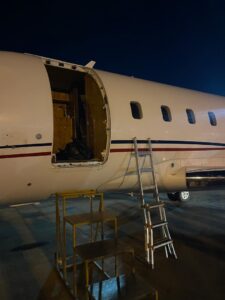
Until the final report is published, the Abuja incident stands as a stark warning of what happens when the fragile boundary between the cabin and the void gives way mid-flight.
Google+
