- FAAN MD: Financing talks for Lagos airport rail extension reach advanced stage
- Riding the Tidal Wave: How CITA Energies navigated 20 years of jet fuel volatility
- Delta unveils major upgrade to Delta One, redefines premium long-haul travel
- NSIB opens probe into Challenger 604 door separation incident
- Private jet forced into emergency landing in Abuja after door detaches



Nigeria’s aviation space struggling to harness potential @ 63

The aviation industry in Nigeria has evolved over time in the past 63 years. The sector has made an appreciative impact on one hand and faces numerous other challenges that have hampered it from achieving its potential. The growth in the sector took a long time to achieve. The question is: Is the sector supposed to remain where it is today? The answer is no, writes WOLE SHADARE
Peep into sector

Despite the aviation industry being confined to the doldrums, there are positives over the years to show that the sector can really achieve greatness only if the real actors in the sector come up with a template to harness the potential.
From inception, there seemed to be a clear-cut direction for the industry but along the line, so many factors slowed down the progress the country would have made far better than where the sector is at the moment.
While the sector has done very impressively in some areas, it has lagged behind in many other areas. But in terms of aviation security, the sector ranks high but not totally where it should be. In the area of air navigation, success has been recorded but not to the level Nigeria ought to be. In the area of airline business, the nation has witnessed so many deaths of airlines, which came with so much promise but were short in delivery.
Many of the airlines are still grappling with many factors that have led to the high turnover of airlines in Nigeria than anywhere else in Africa and Europe. Those things the operators complained about that have fast-tracked the exit of over 120 airlines since the liberalisation of the airline business in Nigeria in 1984 are yet to go away.
In fact, the carriers are more challenged now than they were 25 years ago; no thanks to alleged vicious government policies, high taxes, and general operating environment.
Going down memory lane
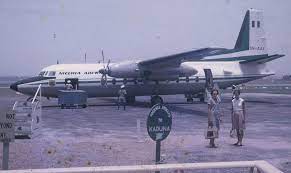
The story of the aviation business in Nigeria cannot be written without a recourse to the national carrier, Nigeria Airways. On May 1, 1959, Nigeria Airways Limited was inaugurated during the administration of Chief Samuel Ladoke Akintola as Minister of Aviation. That was the year Nigeria got its fledging national airline.
Chief Raymond Amanze Njoku succeeded Chief Ladoke Akintola as the first supervisory minister to midwife the new airline.
Nigeria Airways, therefore, offered a core of experts that cut across every stratum of the nation’s aviation sector. It was the production mill of experts and technocrats that moved ahead to write their names in gold by providing the lee-way through which today’s aviation industry was built.
The airline monopoly was broken following the deregulation of the airline sub-sector by the federal government in 1985 brought private investors into the air travel market. Airlines like Okada Air, ADC Airlines, Kabo Air, and later, ADC, and many others competed with Nigeria Airways, Nigeria till its liquidation in 2004.
The industry was deregulated to create more jobs, and airlines were established but many of them have remained weak with no strong maintenance facilities.

Most of the airlines are struggling. The infrastructure development and maintenance is deficient. The regulator needs to pay more attention to ensure that the airlines survive.
In the 1980s and 1990s, the government embarked on massive airport infrastructure as the facilities then were adequate for the traffic. The boom in air traffic occasioned by the growing middle class led to infrastructure needs.
Over the years, the government shirked its responsibility to invest heavily in infrastructure which has caught up with the system and the entire aviation value chain.
The surging passenger growth necessitated the improvement and expansion of facilities in some aerodromes. Some of them have been remodeled while new terminal facilities were built in some of these airports.
Impeccable aviation safety record
The appointment of Dr. Harold Olusegun Demuren in 2005 led to a significant improvement in the country’s aviation industry with the help of various Ministers of Aviation who gave the backing of autonomy through regulations to the Nigerian Civil Aviation Authority (NCAA). The NCAA was overhauled to meet the challenges of modern aviation regulations in tandem with global standards.
Nigeria’s aviation safety record has been impeccable. 2013 was the last time the country recorded an air crash involving commercial airlines; this can be attributed to strong regulation by the Nigerian Civil Aviation Authority (NCAA). The aviation regulatory body has its own deficiencies ranging from a lack of impactful training and recruitment of key personnel to man critical positions. Notwithstanding, the regulatory body has done pretty well.
The agency is the bedrock of the aviation industry, whose performance determines the fortunes and misfortunes of the sector.

Since August 2010 when Nigeria obtained its first Category One status from the US Federal Aviation Administration (FAA), Nigeria has sustained the standard, which enabled the FAA to continue to retain the country on that status.
As part of the FAA’s IASA program, the agency assesses the civil aviation authorities of all countries with air carriers that operate or might be authorised to fly to the United States and makes that information available to the public. The assessments determine whether or not foreign civil aviation authorities are meeting ICAO safety standards, not FAA regulations.
In 2010 when Nigeria obtained global safety status, the country was one of just six African countries, including Cape Verde, Egypt, Ethiopia, Morocco, and South Africa, with an IASA Category 1 rating.
Nigerian airlines on death throes
With the exception of one or two airlines that are said to be ‘well funded’, virtually all the carriers are going through excruciating pains that could see them leave the scene. Some of the problems are self-inflicted, majority of the problems are those beyond their control. They are racing against time to remain afloat while they are pinned to the wall.
The Assets Management Corporation of Nigeria (AMCON) Executive Director, Operation, Aminu Ismail, attributed the weakness of Nigerian airlines to poor capital structure, difficulty in accessing cost-effective leases, high insurance costs, access to foreign exchange, and very marginal share of the lucrative regional flights, among others.
Nigerian carriers have an average fleet of between five and eight aircraft, a number not enough to compete with British Airways which has over 400 aircraft.

Delta Airlines has over 500 aircraft. Ethiopian Airlines has over 100 aircraft and this makes it difficult for them to compete. Competition is not realistic for the country’s airlines.
The aviation industry in Nigeria and elsewhere is cutthroat, meaning if they don’t have a critical mass in terms of size, in terms of good management, in terms of fleet, in terms of a good network, it is very hard for them to succeed.
A former President of Aviation Round Table (ART), Dr. Gabriel Olowo, said the major problem of Nigerian airlines was essentially a Nigerian business environmental factor.
Nigeria Air saga
The idea to float another national airline after the demise of Nigeria Airways by the administration of former President Muhammadu Buhari was met with stiff opposition because of the manner the project was packaged. Airlines under the aegis of Airline Operators of Nigeria (AON) described the project as lacking in transparency while the former Minister of Aviation, Hadi Sirika defended the project and its importance to the aviation industry.

The existing Nigerian airlines had from day one opposed to it not because it was a bad idea to have a national carrier but because they were of the view that they would totally lose out and find it extremely difficult to compete with an Ethiopian Airlines-backed national airline for Nigeria. They had also queried the process that threw up Africa’s biggest airline as a strategic investor.
Revamping AIB/NSIB
One of the best gifts to aviation is the Accident Investigation Bureau (AIB) which later transmutes to the Nigerian Safety Investigation Bureau (NSIB).
The remarkable work of the agency in the past seven years has helped to change the narrative about the agency. It is one that has helped to position the sector in a better light.
Retired Managing Director of the United States’ National Transportation Safety Bureau (NTSB), Mr. Dennis Jones, recently lauded the achievements of the agency under Engr. Akin Olateru, who took over in 2017.

Jones in a letter to the NSIB boss recently said: “I can confidently say that the gains and strides made by NSIB under your leadership have been extraordinary, if not altogether unprecedented, and consequently the organisation has become a world-class and premiere accident investigation organisation worthy of global recognition for its contribution to aviation safety and as an exemplary model of being an enterprising government agency.”
Jones further described Olateru as a visionary leader who had used his position to distinguish himself since his appointment as a Commissioner in AIB-N, stressing that he had placed himself in the upper echelon of luminaries in the aviation safety community and beyond.
Last line

Stakeholders say, though the industry has been plagued by many challenges, it will surmount these challenges with the correct and workable policies, strict regulatory oversight, and adherence to standards, recommended practices, and operating procedures
Google+