- vPASS: Biometric lock on fragile door
- Inside the ‘inelastic’ economics, looming oversaturation of Nigeria–London route
- Umza Air unveils fleet expansion, Hajj plans, nine-city domestic network
- United Nigeria launches Jos route expansion to Lagos, Kano, Owerri
- Why British Airways, Virgin Atlantic Are Capped. What Nigeria Wants in Return



Inside the ‘inelastic’ economics, looming oversaturation of Nigeria–London route
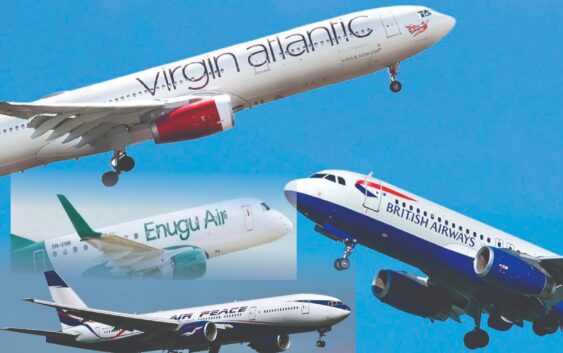
As foreign carriers lobby Abuja for extra frequencies and domestic airlines race to claim their share of London slots, a fierce commercial and policy debate is unfolding over the future of West Africa’s most prized long-haul route, writes WOLE SHADARE
For decades, the airspace between Nigeria and the United Kingdom has been treated in aviation as the golden goose of West African long-haul travel; a corridor anchored by colonial history, commercial ties, an entrenched diaspora, educational migration, and medical tourism.


Yet as 2026 draws to a close, a fierce commercial and policy debate is unfolding over whether this lucrative route is heading toward dangerous oversaturation or whether its notoriously inelastic demand is simply colliding with an outdated bilateral ceiling.
Recently, diplomatic activity around the Nigeria–UK Bilateral Air Services Agreement (BASA) has accelerated sharply. British Airways, operating 14 weekly frequencies split evenly between London Heathrow–Lagos and Heathrow–Abuja, dispatched its Chief Planning Officer, Neil Chernoff, to Abuja to press the Federal Government for additional frequencies and access to more Nigerian cities.
Alongside Virgin Atlantic’s daily Heathrow–Lagos operation, British carriers have exhausted the 21 weekly frequencies the existing pact permits to the UK.
Meanwhile, Nigeria’s Air Peace has grown from its March 2024 Lagos–Gatwick launch into a 13-weekly operation spanning Gatwick and Heathrow from Lagos and Abuja.
Now, Enugu Air, partnering with Omni-Blu Aviation via a wet-leased EuroAtlantic Airways Airbus A330, is preparing to add four weekly Lagos–Gatwick flights starting on December 10, 2026.
With Aviation Minister Festus Keyamo signalling readiness to review the BASA-provided foreign carriers embrace meaningful code-sharing with domestic operators, stakeholders face a fundamental paradox: if more seats flood the corridor, will fares collapse for passengers, or will carriers trigger destructive yield erosion on a route whose underlying demand refuses to grow on command?
Anatomy of an inelastic route
To understand the impact of swelling capacity, one must discard textbook assumptions about air travel economics.
On global leisure routes, cutting fares by thirty per cent stimulates waves of discretionary weekend tourists. The Nigeria–UK market behaves differently. Demand between Lagos, Abuja, and London is overwhelmingly price-inelastic.
Whether a return economy ticket sells for ₦1.4 million or ₦3.2 million, the core passenger profile remains rigid: Nigerian students travelling for academic terms, families bound by kinship, corporate executives, diplomats, and medical tourists.

Moreover, restrictive UK visa regimes and strict immigration vetting act as a structural gatekeeper.
Even if an airline slashed base fares tomorrow, millions of Nigerians could not impulsively board a flight to London without navigating months-long visa hurdles and substantial proof of funds. Because the pool of visa-holding passengers is largely fixed in the short term, lower fares rarely expand the overall market.
During the foreign exchange crisis, when over $850 million in airline funds was trapped in Nigeria, skyrocketing fares did not empty planes; travellers simply booked earlier or downgraded cabins.
Conversely, when seat capacity expands faster than visa issuances and purchasing power, airlines end up competing for the same cohort of passengers.
‘Oversaturation’ in a high-cost environment
Critics warn the corridor is flirting with oversaturation, where available seat kilometres outpace organic growth and force airlines to discount below sustainable costs.
At first glance, this seems contradictory given British Airways and Virgin Atlantic’s strong load factors and Virgin’s deployment of flagship Airbus A330-900neo aircraft on Lagos.
The explanation lies in seasonal disparity. During “Detty December,” Easter, and the August–September student rush, the corridor is chronically undersupplied, and seats sell at top-tier fares.
However, across off-peak shoulder months February, March, May, October, and November, direct flights face aggressive competition from sixth-freedom carriers like Qatar Airways, Emirates, Turkish Airlines, Lufthansa, Air France-KLM, Royal Air Maroc, and Ethiopian Airlines, which siphon off price-conscious travellers via their hubs with lower fares and generous baggage allowances.
As direct flights rise from 34 weekly frequencies toward the 42-flight bilateral ceiling and potentially higher if BASA is expanded, off-peak months will become a brutal battleground where excess seats can only be filled by stealing market share.
Legacy giants vs. Nigerian carriers
Additional frequencies carry vastly different stakes depending on where an airline is based. For British Airways and Virgin Atlantic, extra flights are a strategic weapon backed by global network feed beyond Heathrow, lucrative multinational corporate contracts, deep balance sheets, and cheap aircraft financing.
Crucially, point-of-sale diversity insulates them: much of their revenue comes in Pounds or Dollars, cushioning them against Naira volatility and allowing premium-cabin profits to subsidise economy-fare wars during slow months in Lagos.
For Nigerian carriers, the calculus is unforgiving. Operating wide-body aircraft out of Lagos or Abuja carries punishing structural penalties: steep aviation fuel prices, exorbitant sovereign-risk insurance premiums, high maintenance reserves, and costly hard-currency wet-lease (ACMI) rates, all while earning revenue predominantly in Naira.
Air Peace’s 2024 entry successfully forced foreign carriers to slash historic high fares, delivering a major consumer victory. Yet sustaining thin margins long-term is far harder.
With Omni-Blu and Enugu Air entering alongside Air Peace, fragmented domestic operators risk cannibalising one another in a race to the bottom rather than uniting to utilise Nigeria’s remaining four BASA frequencies through coordinated hub-and-spoke feed.
Taxes, surcharges, and the price floor
Regulatory charges also severely limit how low ticket prices can fall. Base fares represent only part of a ticket’s cost.
Departures from the UK incur Air Passenger Duty (APD) set at £102 for economy and £244 for premium cabins in 2026, with hikes scheduled for April 2027, while Nigerian tickets carry a 5 per cent NCAA Ticket Sales Charge, security levies, and hefty airport fees.
Because these statutory charges are fixed in hard currency or pegged as percentages, they create an immovable price floor.
Even if oversaturation drives net base fares near zero, final checkout prices in Naira remain elevated, compressing airline margins until weaker carriers collapse, repeating a graveyard pattern that claimed Bellview, Arik Air, and Med-View.
Avoiding self-sabotage

Competition has rightfully ended unchecked foreign monopoly pricing on the London route, but expansion must not become asymmetric self-sabotage.
Keyamo’s insistence on tying foreign capacity expansion to genuine code-share and interline partnerships is a vital policy lever; true reciprocity requires foreign carriers to feed domestic Nigerian airlines rather than bypass them.
Equally urgent is fixing domestic bottlenecks through single-digit aircraft financing, seamless terminal transfers in Lagos and Abuja, and eliminating multiple taxation.
Last line

Without disciplined capacity management, interline cooperation, and lower local operating costs, unchecked frequency growth risks turning West Africa’s most prized corridor into a costly endurance test only foreign mega-carriers can survive.
Google+