- Airbus forecasts 1,640 new passenger aircraft for Africa by 2045 as traffic triples
- SAATM Stagnation: Keyamo, Demuren, Sosina to lead discourse at 2026 SAPTCO lecture
- AASA urges immediate execution to unlock Africa’s aviation growth potential
- Defying The Graveyard: How Aero Contractors outlasts Nigeria’s aviation mortality trap
- Unions dismiss AON’s threat to shut operations, accuse Air Peace of taxiway security breach



Ghost Schedules, Broken Dreams: The hidden toll of Nigeria’s flight delay crisis
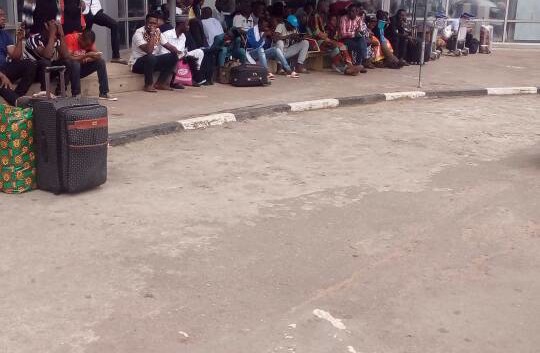
While severe delays frequently trigger passenger anger and airport altercations, the crisis is rarely the fault of a single entity. It stems from a combination of systemic, technical, operational, and regulatory factors across the aviation ecosystem, writes WOLE SHADARE
It was supposed to be a routine 50-minute hop.


Stanley Wisdom, a Lagos-based software consultant, arrived at the Murtala Muhammed Airport Terminal 2 (MMA2) at 6:00 AM on a humid Thursday morning, ticket in hand for a 9:55 am flight to Abuja. He had an afternoon presentation with a government agency, a deal that represented months of bidding and millions of Naira in prospective revenue.
By 2:00 PM, Wisdom was still on the cold metal seats of the departure lounge. The flight status board, rendered almost ornamental by hours of static displays, offered no updates. At 3:30 PM, a crackling, barely intelligible announcement delivered the final blow: “Flight delayed due to operational reasons.” By 6:00 PM, twelve hours after he checked in, the flight was outright cancelled.
No food voucher was offered. No hotel accommodation was provided. The prospective client in Abuja, tired of waiting, called off the meeting and awarded the contract to a competitor.
“They didn’t just delay my flight,” Wisdom muttered, his eyes bloodshot, gesturing toward a boarding gate swallowed by angry, shouting passengers. “They delayed my life.”
“We are trapped,” he said quietly, looking around the crowded departure hall. “We pay high fares, but we are treated like an afterthought.”
Wisdom’s ordeal is not an isolated tragedy; it is the daily reality for thousands of travellers across Nigerian airports.
Domestic travel in Africa’s most populous economy has devolved into an unpredictable game of chance. Yet, behind the fraying tempers at boarding gates, a fiercer, systemic war is playing out in executive boardrooms, a high-stakes face-off between Nigeria’s carrier, Air Peace, and the apex regulator, the Nigerian Civil Aviation Authority (NCAA).
At the heart of this confrontation lies a fundamental dispute over data, regulatory transparency, and the existential paralysis of an industry pushed to the brink.
Waiting rooms of frustration
Inside the departure halls of many airports across Nigeria, time moves differently. Passengers sit on suitcases, spill over onto tiled floors, and cluster around customer service desks that are frequently abandoned the moment tempers flare. The emotional and economic toll of flight disruptions in Nigeria is staggering.
Business executives miss multi-million Naira board meetings; perishable cargo deteriorates in airport holds; and international connections are missed, forcing travellers to buy expensive last-minute long-haul tickets out of pocket.
Passengers travelling for urgent medical procedures find themselves stranded for days, often without access to their packed medication. Chronic uncertainty breeds a permanent state of anxiety for domestic travellers, turning routine transit into a demoralising ordeal.
Under Part 19 of the Nigeria Civil Aviation Regulations (NCAARs) 2023, passengers have specific rights: refreshment after two hours of delay, telephone calls and meals after three hours, and full hotel accommodation and transport if delayed overnight. In practice, enforcement is patchy, and passenger compensation remains largely theoretical.
The Face-Off: Air Peace vs. NCAA
The simmering discontent among passengers erupted into a full-scale institutional conflict when the NCAA released what the airline termed granular performance metrics for August 2026.
The regulator’s monthly performance report painted a damning picture of the domestic sector: out of 7,961 domestic flights operated across all airlines in August, 4,765 were delayed. Air Peace was singled out with 1,864 recorded flights, 1,330 delays, and seven cancellations.
The airline’s defence
In a detailed rebuttal signed by Chief Operating Officer Oluwatoyin Olajide, Air Peace asserted that the NCAA systematically omitted over 700 of its fully completed flights from the audit. According to the airline, Air Peace actually operated 2,564 completed flights in August, not 1,864. She stated that leaving out 700 flights artificially inflated its delay percentage.
She explained that internal logs revealed that only 391 delays (roughly 15%) were attributable to internal factors like unscheduled maintenance or operational issues, hinting that the remaining 85% were driven by factors outside the carrier’s control such as deficient tarmac space, airborne holding patterns, and airport congestion, ground equipment damage and bird strikes—including an incident in Abuja where a Boeing 5N-BYG suffered engine inlet cowl damage, costing $1.8 million to repair and grounding an asset that carries 1,000 passengers across eight daily sectors.
She also cited a 14-day lingering impact from union picketing on August 11, which she said did incalculable damage to its operations.
The regulator’s position
The Director-General of Civil Aviation, Captain Chris Najomo, alongside Director of Public Affairs Michael Achimugu, stood firm.
The NCAA countered that Air Peace’s high volume of delays stems from an acute capacity shortage, as it schedules more flights than its active, serviceable fleet can realistically support.
He said, “It is normal for Air Peace to dispute the report because it is the airline most hit by flight delays due to its sheer fleet size,” Captain Najomo noted. “Rather than dispute the data, it should serve as an opportunity for the carrier to reflect on its operations.”
Anatomy of Failure: Why Nigerian Flights are delayed
Attributing Nigeria’s aviation crisis solely to airline inefficiency or regulatory spite misses the broader structural collapse. Industry experts point to a complex web of interconnected failure points, such as collecting revenues in Naira while paying over 70% of costs (maintenance, leases, spares) in USD.
Aircraft remain grounded abroad awaiting Forex allocation for mandatory C-checks and short-time operations into some airports due to lack of airfield lighting. Non-functional airfield lighting at most airports, late fuel supply, and prolonged taxi times and airborne holding patterns burn expensive fuel while delaying downstream sectors.

Debt, remittance, and safety
As Group Managing Director of Finchglow Holdings, Bankole Bernard recently highlighted that many domestic airlines are quietly running in the red.
The dispute over the 5% Ticket Sales Charge (TSC) and Cargo Sales Charge (CSC) collected from passengers by airlines but often withheld due to legacy debts underscores a severe liquidity crisis.
When an airline is financially distressed, it begins to cut corners,” Bernard warned. “The regulator must compel carriers to open their books for total operational and financial audits. Financial discipline is inextricably linked to air safety.”
Overhauling the Industry
If Nigeria is to escape this cycle of operational chaos and regulatory friction, piecemeal reforms will no longer suffice. A comprehensive overhaul requires action across four critical pillars, including a unified central data platform and real-time, shared data integration across NCAA, FAAN, NAMA, and airlines to eliminate reconciliation disputes.
To eliminate disputes, the industry needs automated revenue & regulatory reconciliation and a transition to automated BSP/real-time remittance platforms to clear legacy debts and ease Forex access.
The spectacle of an airline and its regulator arguing over basic flight counts (1,864 vs. 2,564) undermines international confidence.
A centralised, automated passenger and flight data platform accessible simultaneously by the NCAA, Federal Airports Authority of Nigeria (FAAN), and Nigerian Airspace Management Agency (NAMA) is mandatory to establish a single source of operational truth.
Regulators must firmly enforce fleet-to-schedule ratios. Airlines operating a depleted fleet due to maintenance groundings must be required to scale back published flight schedules immediately, rather than selling tickets for “ghost flights” that inevitably end in multi-hour delays or cancellations.
Last line

Nigeria’s aviation sector stands at an inflexion point. The face-off between Air Peace and the NCAA is not merely a statistical dispute; it is a symptom of a system operating beyond its structural capacity. Until these problems are tackled, Nigerian travellers will remain caught in the web—paying top-tier prices for bottom-tier predictability, waiting indefinitely for a system that desperately needs to fix its wings.
Google+