- Kila Debunks ‘Fake Professorship’ Claims, Moves to Court
- FAAN sparks Next-Gen interest with NYSC, high school aviation career programme
- FAAN targets seamless travel at MMIA with Biometric gates, digital upgrades
- United Nigeria Airlines headlines 2026 Ndigboamaka traders cup
- How market dynamics made flying accessible again



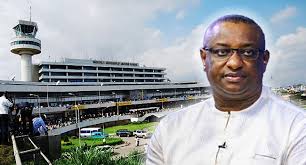
Why $447 million not much for Lagos terminal 1 reconstruction, other facilities-Minister
- Kano, Abuja, P’H int’l terminal grossly underutilised with less than 30% traffic
- BPE scrutinised, fixed cost
The Murtala Muhammed International Airport, Lagos, built to facilitate nearly 600,000 annual passenger traffic, has been over-stretched, coupled with decrepit facilities that have made air travel cumbersome despite all palliative measures over the years to give it a facelift.

The terminal currently processes more than 12 million international and regional passengers annually; a situation that puts pressure on the existing facility and makes it difficult to rank any Nigerian airport among the best in Africa in terms of aesthetics, facilitation and security.

The Minister of Aviation and Aerospace Development, Mr. Festus Keyamo, had at Wole Shadare‘s book launch on May 23, 2025, announced the plan of the Federal Government to tear down the 47-year-old terminal building reconstruction, roads, avio bridges and carousels, among other facility replacement.
This is coming as the brand new international terminals in Kano, Abuja, and Port-Harcourt are grossly underutilised due to the traffic that is less than thirty per cent of their capacities, according to the Minister.
Just last week, the Ministry secured N712 billion ($447 million) approval from the Federal Executive Council (FEC) for renovating terminal 1, expanding terminal 2 and the procurement of other infrastructure to give the airport the international status it truly deserves.
The Bureau for Public Procurement, which he said scrutinised and fixed the final cost of this project, did a fantastic job for the nation.
Analysts, however, described the budget for the project as enormous and called for a review downward.
Some others have described the cost as ‘Not too much’, explaining that Angola’s new airport cost $3.8 billion; Cambodia Airport costs $1.3 billion, while that of Nigeria, which is said to be a total reconstruction or rebuilding, is $477m. They described it as cost-effective and funded domestically without loans.
The upcoming developments include a new road network, a modern, well-organised, and efficient road network will be developed to improve access to the airport, easing congestion and enhancing the overall travelling experience.
connection building and skywalk.
A Skywalk will be constructed to integrate the car park building with T2, and a connection building will be established to link T1 and T2. This infrastructure is expected to transform the previously independent terminal buildings into a unified complex, improving passenger flow and airport management.
During the rehabilitation phase, a temporary departure hall will be established. It will be well-organised, clean, and comfortable to ensure convenience for all travellers.
It comes with a redesigned central square landscape: The landscape in the central square, located in front of the terminal buildings, will be completely redesigned to create a welcoming atmosphere for arriving passengers, offering a first impression that reflects the pride and spirit of our nation.
Speaking to Aviation Metric, Keyamo said that due to years of neglect and because the traffic over time quadrupled beyond its capacity, the building and facilities at Terminal One became decrepit.
“We are reimagining the future of the MMIA, not just rebuilding a terminal, but elevating Nigeria’s aviation experience to global standards. The new T1 will offer faster check-in, smarter security, brighter lounges, and better shopping—all built for you”.
This project, he reiterated, represents a future-focused infrastructure upgrade and a solemn commitment to every traveller passing through this national gateway, adding that people’s understanding and support are helping them build the MMIA of tomorrow—more vibrant, convenient, and world-class—truly the pride of the nation.
The upgraded terminal will elevate MMIA to an international platform, establishing it as a leading aviation hub in West Africa, becoming a source of national pride and meeting the highest global standards. We have been engaged in some patch jobs over the years just to make it a bit presentable. Now, shorn of all the rhetoric, what we simply want to do is to strip down that building, including the entire roof (leaving only the carcass), then re-design/reconfigure it and build a brand-new airport for the nation to meet modern, international standards that can also cater for the increased traffic. Both wings D and E would be affected.”
“There are two international terminals in Lagos. Terminal One is that old building directly facing the long stretch of road leading to the airport, built & commissioned in 1979 by the Obasanjo-led Military regime. It has two wings known as WING D and WING E.
“Terminal Two is the new building on the right-hand side as you drive into the airport, started by President Jonathan’s govt. With a Chinese loan, completed during President Buhari’s govt (with the loan) and made operational during President Tinubu’s first month in office.”
He explained that his Ministry got approval to expand Terminal Two and the small apron to accommodate more aircraft, including wide-body aircraft.
“That is not all; we are constructing two new independent ring roads in and out of the airport (one for departure and one for arrival) and a bridge that will take travellers directly to the upper floor of the terminal two departure lounge, instead of lifting our luggage up the escalators when we are departing. It is a design error we intend to correct.”
He further stated that they were equally introducing smart solutions to the new designs to deliver a smart airport to Nigerians that can compete with any airport in the world.

His words, “Nigerians will be proud of what we are going to deliver. And take note, this will not be done by a loan from anywhere, but by the Renewed Hope infrastructure Development Fund, which is one of the gains made from the removal of subsidies.”
Google+