- Transport Summit Holds Friday
- What Abuja private jet door blowout reveals about aviation safety
- Jet fuel price volatility threatens supply companies' viability, warns CITA Energies Chief
- FAAN MD: Financing talks for Lagos airport rail extension reach advanced stage
- Riding the Tidal Wave: How CITA Energies navigated 20 years of jet fuel volatility



Walsh: It’s bizarre that a lot of traffic from Africa to Africa goes over the Middle East
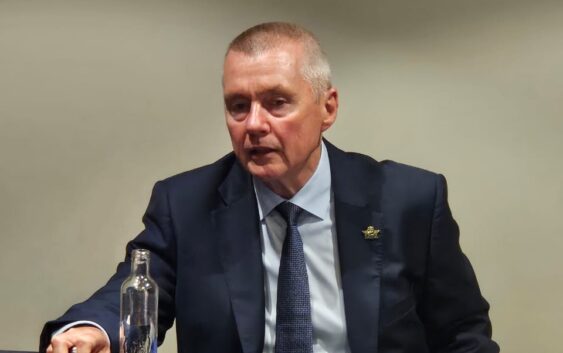
Willie Walsh is the outgoing Director-General of the International Air Transport Association (IATA). In this interview with WOLE SHADARE at the IATA82nd AGM in Rio de Janeiro, Brazil, he speaks about issues, prospects of the global airline and aviation industry, Africa’s slow implementation of the Single African Air Transport Market (SAATM) and how the continent can realise its potential

Willie, could you give an appraisal of your tenure as you leave your role as the organisation’s Director-General?

I’d say it’s good, I’ve really enjoyed my time. Five years, it’s gone really fast, and I look back with fond memories, and I wish whoever takes over the very best of luck, and I’m going to look forward to sitting in the audience heckling next year rather than having to work for a few days. Actually, I think the AGM here was great, and I think next year in Xiamen will be fantastic. For those of you who haven’t been there before, it’s a very exciting place, unlike most of the cities I have visited in China. I look forward to that.
What has been your experience in the last five years as IATA DG?
Well, you know, when I joined IATA, I had one objective: to be a strong voice for the airline industry. I joined at a time of significant crisis, going through COVID. I am passionate about this industry. I think the fact that I am going back into it as a CEO role shows how much I enjoy it. I have enjoyed the freedom to speak on behalf of the industry and to be critical where necessary. So, I think it’s a fantastic role. As I said, whoever takes over from me, I think, will enjoy it as well.
What would you wish you’d done that you haven’t done?
If I am honest, I’m really pleased with everything. I have seen the membership. We now have 109 more airlines than when I started, for a total of 377. We have increased the representation of the low-cost segment, as I wanted to. Maybe the thing I regret, or find myself regretting, is that I didn’t have a go at engine OEMs earlier. In the main, that’s down to the fact that I couldn’t really assess their individual properties because they were hidden within the parent companies’ accounts. So I couldn’t see it as clearly as I’ve been able to see it recently.
Was there something that you wish you had done during your time but didn’t have the opportunity or the time to do? Or something that you wish you had done differently?
I think one of the things I have enjoyed about this AGM is reiterating that I don’t think this is a crisis for the industry. I think individual airlines are facing a crisis. But at the industry level, we still believe it will be profitable at lower levels than we initially expected. And the reason for the lower profitability is a combination of high oil prices and the shift in the Middle East from profit to loss. So, it’s not just all about the oil price. We’re looking at an industry where we project 2.1 per cent growth this year. But if I strip out the fact that we’re expecting the Middle East carriers to be 11.4 per cent down on last year, the underlying growth for the rest of the industry is 3.5 per cent. So, in an environment where we have such high fuel costs to be able to forecast profitability and see continuing growth, I don’t think I’ve seen that combination before. I’ve seen where the industry recovers, oil prices are high, and then you’re profitable. But to be profitable in the period where the oil price spikes like that, that’s something unusual. The focus has naturally been on the impact of high oil prices, what’s happening in the Gulf, and how long this high-oil-price environment will last. There had been concerns before the AGM, maybe in the lead-up to the AGM, about the supply of jet fuel. I think those concerns have abated. But the issue of the environment and SAF remains.
Kenya relies on tourism, exports and foreign investments. In dollar terms, what is Kenya losing every year due to aviation bottlenecks? So, what economic gains could be unlocked?
It’s not unique to Nairobi or Kenya and, in fact, I’ve discussed this with other regions as well. One of the problems we face, or a lot of airlines face, particularly in an environment where the oil price is high, is that their dollar exposure has significantly increased. And in many areas of the world, we have seen the dollar strengthen against local currencies, which makes the problem worse again. Now, the dollar has weakened against most currencies, but many currencies have weakened against the dollar as well. And what you have is an environment where you can have up to 80 per cent of your costs dollar-denominated and 90 per cent of your costs are in local currency, or your revenues are in local currency. And it’s just impossible, it doesn’t matter how good you are. These are challenges, as I said, that everybody is facing. In Africa, you have higher underlying operational costs than in most other parts of the world. You have higher fuel costs than most parts of the world.
What are your thoughts on the survival prospects of smaller Middle Eastern airlines in this sort of operating environment?
Yeah, Middle Eastern airlines have been doubly hit because they’re facing network disruptions and high oil prices. But the good news, if it matters, where I was, I would say the positive is that it’s getting better. As I said, if you look at March, Middle East airlines were down 60 per cent in March. We’re forecasting them to be down 11 per cent for the year, which suggests a progressive increase and recovery in capacity. So, at least we believe demand will return.
The African market has struggled to reach a 2 per cent market share over the past 10 years. Nothing changed. So what’s your recommendation for them in this area?
Well, to keep sending the message that Africa will never reach its full potential unless it adopts a single African market. Yeah, that’s the answer. Now, the good thing is that Africa is benefiting a little from the Middle East. Like we are looking at 10 per cent growth in Africa this year, which is very encouraging, because, as you know, a lot of traffic from Africa goes over the Middle East. A lot of traffic from Africa to Africa goes over the Middle East, which is bizarre. The fact that to connect within the continent, you’re flying outside the continent. That shouldn’t happen. But it will continue to happen until we make it easier for airlines to connect internally. And the best way to do that is to provide greater freedom for airlines to operate across the African continent, rather than continuing to operate as we have for many years. The potential is huge. It’s OK, it’s, you know, as I said, in 2000, in 1990, it was two per cent. I think this year, it will be 2.4 per cent. What I will say, if my successor is interested, is that it’s an area with potential. And the solution exists. I think that’s the thing that is so discouraging: everybody knows what the answer is and has agreed on it, but isn’t willing to implement it. So I live in hope that someday I will see Africa grow from two per cent to where it should be, which, in realistic terms, Africa should be six to seven per cent today. And, no reason why it couldn’t be greater than that. When you look at what the Middle East has done, as I said, at a global level, they were the size of Africa in 2000, at 9.5%. They were slightly bigger. They were about 2.5%. They’re now 9.5%, and at the international level, they are 14.5%. And, they don’t have anything that Africa has. You can imagine what could have happened, and should have happened, and, you know, potentially will still happen.
Is there an opportunity through the alliance structures to start developing alliances in Africa and subsidising them?
No, I don’t see it because the structural challenges in Africa will continue. It doesn’t matter who’s making the investment. Quite honestly, the case for investment is weak when you have all of these structural barriers in the way. So, when I was at British Airways, we had a franchise carrier at Convair. We had a shareholding in Convair, so I was very familiar with the challenges there, the operational risks and the financial costs of operating it in Africa. So I don’t see that being in an alliance or approaching it from an alliance perspective will make a difference. As I said, I think the answer to Africa is well known, and SAATM is there. Everybody knows what it would mean. Just go ahead and implement it. I accept that some people will be afraid because they’ll ask, “Am I going to benefit?” It’s not about an individual country or an individual airline. You know, you should really be talking about how we need to do this for the African continent. As I said, the idea that to get from Africa to Africa, you go by the Middle East just doesn’t make sense to me.
One of the problems we have in Africa is the high charges and high taxes. IATA has spoken eloquently about that. What do you think the government can do? Especially in Nigeria, to reduce taxes and charges that have become a major disincentive to air travel in Africa?
 Walsh
Walsh
Well, Nigeria should be a powerful aviation market, given the country’s population and underlying wealth. There’s no reason why it shouldn’t. The problem there is, you know, the infrastructure has not developed at the pace it should have. But it’s principally down to the cost of operating in Nigeria and the uncertainty that that brings into the market. So you are not going to get airlines to invest when they have other alternatives to invest and to make a – you never have a guaranteed return, but maybe an easier return. I think it is this balance between governments that can count the tax revenue because they can see it or believe in the economic benefit that you’re going to get. All we can do is keep pointing to countries like Sweden, where they introduced a tax on aviation and then wondered why their economy was being hit so hard. And then realised, actually, that it had a lot to do with the loss of so much connectivity. In many cases, even after removing the tax, they won’t regain all the connectivity they had. So it’s a leap of faith on the part of governments to believe that you’ll get greater economic benefit overall, and you’ll grow your tax base rather than rely on the taxation that you are getting from airlines.
Google+
That’s a really interesting point about the traffic routes, especially considering the SAATM progress. It seems like a lot of logistical hurdles are still in the way.
Absolutely
This is a topic that’s close to my heart… Best wishes! Exactly where are your contact
details though?
shadare2005@yahoo.com