- Babalakin lauds Tinubu over 19 years BASL, FG dispute resolution, pledges mass job creation
- Air Peace strengthens leadership pipeline with key flight operations appointments
- Transport Summit Holds Friday
- What Abuja private jet door blowout reveals about aviation safety
- Jet fuel price volatility threatens supply companies' viability, warns CITA Energies Chief



MRO: Ageing fleet creates significant market opportunity for Nigeria, Africa’s market
Africa has the oldest fleet average age of any continent in the world. The global average is six years, while in Africa it is 17 years and above. This creates significant aircraft maintenance demands as older ones require more frequent and comprehensive inspection activities to ensure safe operations, writes WOLE SHADARE
Nigerian airlines face significant challenges in the area of Maintenance, Repair, and Overhaul (MRO), primarily due to the lack of adequate local facilities.

This forces airlines to send aircraft overseas for maintenance, leading to increased costs, longer turnaround times, and reduced fleet availability. The absence of a major MRO facility in Nigeria has been identified as a major factor hindering the success and sustainability of Nigerian airlines.

The MRO market is Nigeria is robust not only for the huge domestic traffic but by the sheer number of airlines with Nigeria regarded as one of the countries in Africa with the highest number of airlines and number of airplanes despite the shrinking number of aircraft in service which has been attributed to almost nonexistent aircraft maintenance facilities for C and D checks.
Aero Contractors, which maintains a facility to serve the domestic airlines’ maintenance needs, is commendable; however, the facility cannot offer services to many carriers that have urgent maintenance requirements.
It lacks sufficient manpower to expand its customer base. However, the Aero MRO is said to be the backbone of the carrier as it offers services to itself before extending to other customers; thereby augmenting its revenue and stabilising the carrier that was close to extinction before its current Managing Director, Capt. Ado Sanusi brought his experience to bear as a pilot and astute administrator.
With new approvals from Morocco, Mongolia, Senegal, and Ghana, the airline’s facility now supports aircraft types such as 737NGs and the A319 family.
“We aim to become a one-stop shop for all airlines operating in Nigeria,” said Sanusi, emphasising the growing demand for MRO services in the region.
Aero Contractors, Ibom Air examples
The Ibom Air’s MRO, which has taken too long to complete, serves as another money-spinning venture for the airline when put to use. It would serve many maintenance needs of many airlines in the country and save the country enormous Foreign Exchange required for repairing their airplanes overseas.
The estimated $1 billion annually spent on the maintenance of aircraft outside the shores of the country by indigenous airlines may drop as the Akwa Ibom State government completes work on the facility.
Ibom MRO could occupy two Boeing 747 aircraft side by side, while the facility could contain about eight aircraft at a go. Most Nigerian airlines carry out maintenance of their fleet in other African countries like Ethiopia, South Africa, Europe and America, thereby costing them more to ferry their aircraft abroad. The Ibom MRO is the largest in West and Central Africa and remains the fourth largest on the continent.
Depending on what aircraft you are maintaining, you can have eight of them at once under maintenance. That is a huge capacity and that goes for all aircraft in the range of A320 and Boeing 737 series.
Successive governors in Akwa Ibom State had helped to ensure continuous growth in the aviation industry through investments. The governors had invested in Ibom Air, the airport and MRO. It as a game-changer in Nigeria’s aviation industry.
The two examples of Aero Contractors and Ibom Air’s MRO facilities underscored the inability of airlines to realise how important having indigenous maintenance facilities could help reduce their cost. It equally shows how lucrative the business can be despite the huge cost of setting up an MRO. It doesn’t come cheap but it is worth all the dime spent. It is the backbone of airlines.
Burgeoning MRO market
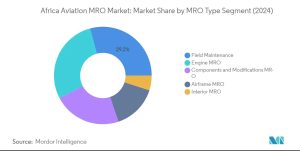
All the major airlines in Africa, Europe, the United States and the Middle East rely on their MRO to keep their aircraft in the sky all the time while offering services to customers; thereby, raking in several billions of dollars to their coffers.
The aviation industry in Africa is poised for growth in continuation of the recovery witnessed in the industry. One major sector that will play a critical role in this growth is the MRO services sector.
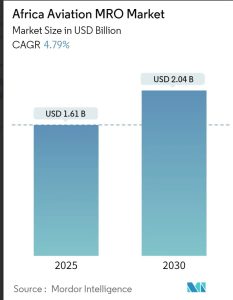
Industry figures project that between 2024 and 2033 Africa’s MRO spend with be about $32.6Billion. Boeing projects that between 2024 and 2043, the Africa MRO market size of $85 billion. With the industry embracing more liberalisation, the spend will only increase. The major challenge is what quantum of this figure will be retained on the continent.
The MRO landscape in Africa is characterised by regional capabilities and heavy reliance on foreign service providers. Only a select few major carriers like Kenya Airways, South African Airways, EgyptAir and Ethiopian Airlines maintain well-established in-house maintenance facilities, while most other operators must send their aircraft outside the continent for major maintenance work.
This dependency on foreign MRO providers significantly increases operational costs and maintenance expenses for African carriers, with aviation maintenance service costs in Africa reported to be substantially higher than the global average.
Recent market developments indicate growing momentum in regional aviation activities and infrastructure development. Tanzania’s aviation sector demonstrated remarkable recovery with passenger traffic growing 49.2% year-over-year in 2022, surpassing pre-pandemic levels by 2%.
Similarly, Nigeria’s air passenger traffic witnessed 8% year-over-year growth to reach 16.2 million passengers in 2022, highlighting the increasing demand for air travel across the continent. These growth patterns underscore the need for enhanced local aviation MRO capabilities to support expanding operations.
The industry is poised for significant fleet expansion and modernisation in the coming decades. According to Boeing forecasts, African airlines will require approximately 700 new aircraft valued at $80 billion over the next 20 years to address increasing air traffic demands. This projected fleet growth presents substantial opportunities for aviation MRO service providers, particularly as airlines seek to establish more cost-effective maintenance solutions within the continent.
Ethiopian Airlines has demonstrated this growth potential, with projection indicating their passenger volume would exceed 13.7 million in 2024, showcasing the expanding scale of Africa’s aviation operations.
To support this growth, the demand for aircraft spare parts and efficient aircraft maintenance solutions will be crucial. Establishing robust local aviation MRO facilities could significantly reduce costs and enhance service efficiency for the continent’s airlines.
Africa currently operates some of the oldest aircraft fleets globally, with an average age fleet of 17 years across the continent. This ageing fleet creates significant aircraft maintenance demands, as older aircraft require more frequent and comprehensive aircraft inspection activities to ensure safe operations.
Major African airlines like Kenya Airways, Ethiopian Airlines, EgyptAir, Royal Air Maroc and RwandAir operate fleets with average ages of between 11.4 and 5.8 years, while some Nigerian commercial airlines operate aircraft as old as 28.1 years each, which are either due for retirement or decommissioning.
The considerable age variation across operators highlights the widespread need for consistent aircraft maintenance support across the continent. The issue of ageing fleets is particularly pronounced in the business aviation sector, where the African business jet fleet maintains an average age of exceeding 20 years, with some aircraft manufactured in the late 1950s and early 1960s.
Many of these business jets, especially those belonging to operators in low-income countries, are poorly maintained and require extensive aircraft repair before returning to service.
Beyond the MRO markets, several African countries are making significant strides in developing their MRO capabilities. Countries like Nigeria, Kenya, Morocco and Tunisia are investing in new maintenance facilities and expanding their service offerings.
The Moroccan aviation sector, in particular, has attracted significant foreign investment in MRO facilities, while Kenya continues to strengthen its position as an East African maintenance hub. Countries such as Ghana, Tanzania, Angola, Sudan, the Democratic Republic of Congo, and Cameroon are also working to enhance their domestic MRO capabilities through various initiatives and partnerships with international providers.
Last line
The growing recognition of the economic benefits of local MRO capabilities has led to increased government support and investment across these nations, contributing to the overall development of Africa’s aviation maintenance sector.
Google+