- NSIB opens probe into Challenger 604 door separation incident
- Private jet forced into emergency landing in Abuja after door detaches
- NAMA spokesman, Musa honoured with prestigious 'Dan Kade of Kontagora' title
- The sky has no gender
- Surging revenues, strong balance sheet drive United Nigeria’s pioneer ₦100bn debt programme



IATA: Setting up sustainable, profitable airline in Nigeria uphill battle
Ranks nation, Afghanistan tough place to set up airline business in the world
- · Lauds Keyamo over Nigeria’s aviation reforms
Wole Shadare, Rio de Janeiro, Brazil
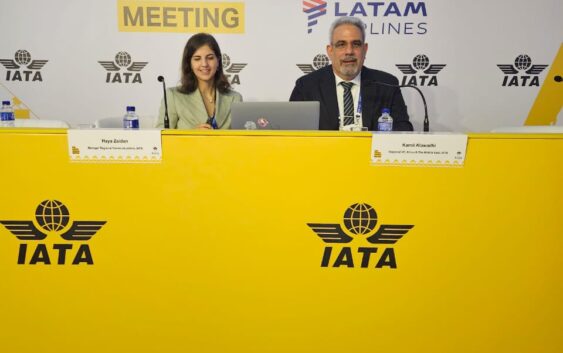
Regional Vice President for Africa and the Middle East of the International Air Transport Association (IATA), Kamil Alawahdi, has listed Nigeria and crisis-torn Afghanistan as two nations where setting up airlines is the toughest in the world.


Al-Awadhi’s critique, while speaking with Aviation Metric at the IATA 82nd Annual General Meeting in Rio de Janeiro, Brazil, captures the immense frustration within the industry with the operating environment in Africa.
He said, “The toughest place to open an airline today is either Afghanistan or Nigeria. Afghanistan, because it’s a disaster, and Nigeria, because it’s unbelievably expensive to operate. Even though you have a transport minister who’s done incredible work to try to stabilise a little bit and reduce some of the costs, it’s still really tough to operate in Nigeria.”
“If you’re an operator. If you’re outside, you’re only subjected to some of these requirements per flight. But for Nigerian carriers, it’s quite hard. But I praise the minister for doing a lot to improve the system he inherited. In a very short period, in less than two years, he’s done a lot for Nigerian aviation.”
While the comparison sounds hyperbolic, his underlying argument highlights a severe, data-backed reality for operators in Nigeria. He stated that operating costs in Nigeria are structurally predatory.
He highlighted that between aircraft insurance premiums that run up to six times higher than the global average due to “high-risk” country profiling, and interest rates on local aviation loans hovering around 25%, local carriers are financially disadvantaged before their first flight even takes off.
The IATA chief further explained that the sheer volume of suffocating airport taxes, passenger service charges, and fuel levies effectively treats the aviation ecosystem as a government cash cow rather than an economic catalyst.
He stated that for international and regional operations, the prolonged saga of blocked funds coupled with sharp currency devaluations has historically wiped out millions in hard-earned airline revenues overnight.
“When you add infrastructure deficits—where some of the most expensive gateways in the region paradoxically feature some of the most challenging runway and navigational environments—it becomes clear why setting up a sustainable, profitable airline in Nigeria is an uphill battle. Al-Awadhi’s comments weren’t just a critique; they were an urgent call for decoupling regulatory/tax policy from shortsighted revenue generation to let the sector finally breathe.”
“I think Africa needs to start fixing itself when it comes to bilateral agreements between the 54 states, and honouring the agreements because some of them do have the agreements, but they are not honouring them. And then start looking outside Africa.”
Regarding the slow implementation of the Single African Air Transport Market (SAATM), a policy designed to open up Africa’s vast airspace for connectivity and profitability, Alawahdi Africa needs to sort itself out before it starts sorting globally.
The African Union launched SAATM to mirror the European open-skies model, yet over 80% of intra-African routes remain underserved or completely unserved.
He pointed out a frustrating irony: it is routinely easier and cheaper to fly from an African capital to Europe or the Middle East than to fly to a neighbouring African country.
While global climate targets, international alliances, and extra-continental routes dominate high-level aviation discourse, Al-Awadhi argued that Africa cannot effectively compete on the global stage when its internal mechanics are fundamentally broken.
Governments eagerly sign multilateral agreements on paper but refuse to implement them in practice, fiercely protecting weak state carriers through restrictive Bilateral Air Services Agreements (BASAs).
Not a few opined that Africa cannot build global aviation powerhouses when its own regulatory frameworks actively stifle intra-continental connectivity and partnership, adding, “An airline cannot scale globally if it is bleeding capital domestically.”

Al-Awadhi frequently cites the punishing cost metrics that are unique to the continent, like aviation fuel in Africa, which is, on average, 17% more expensive than the global average due to supply chain inefficiencies and heavy taxation, including airport, airspace, and statutory charges that are roughly 8% to 15% higher than the global average.
Google+