- Ghost Schedules, Broken Dreams: The hidden toll of Nigeria’s flight delay crisis
- MMA2: Responding to Growing Passenger Traffic Through Capacity Expansion, Collaborative Solutions
- Minister: Passenger growth not enough, Next-Gen airports must drive performance
- Nigeria emerges Africa’s 4th largest aviation market, passenger traffic surges 11.9%
- Iyayi: Communication gaps, inadequate facilities behind airlines' delay crisis



At summit, NAMA MD presents strategic roadmap for Nigeria’s airspace overhaul

The Managing Director of the Nigerian Airspace Management Agency (NAMA), Engr. Umar Farouk has presented a strategic roadmap for the total technical overhaul of Nigeria’s aviation airspace infrastructure.
The NAMA boss spoke at the Nigeria Aircraft Acquisition & Investment Summit (NAAIS) 2026. The summit focused on unlocking growth in Africa’s largest mobility market.


Farouk’s address highlighted how NAMA is transitioning from fragmented regional operations to a unified, tech-driven “One Flight Information Region (FIR).
He emphasised that surveillance is no longer just about tracking planes; it is a national security priority, adding that NAMA is moving toward an integrated architecture that serves both civil and military needs.
He said, “If you are investing in aircraft, you are investing in a system. That system must be stable, transparent, and governed by rules that are respected. Nigeria is strengthening that system. We are aligning our frameworks with global standards under the International Civil Aviation Organisation. We are improving regulatory clarity. We are tightening institutional coordination. More importantly, we are addressing legacy gaps that created uncertainty in the past.”
“You cannot talk about capacity without infrastructure. We are modernising surveillance systems, upgrading communication architecture, and expanding navigation capabilities across the airspace. We are also moving deliberately towards digital integration. Real-time monitoring, data-driven decision making, and automated systems are no longer optional. They are essential.”
While Nigeria is strengthening its aviation governance framework to meet investor expectations, the NAMA boss noted alignment with global standards set by the International Civil Aviation Organisation, along with improved regulatory clarity and tighter institutional coordination.
“Infrastructure development remains a clear signal of intent. NAMA is modernising surveillance systems, upgrading communication architecture, and expanding navigation capabilities across Nigeria’s airspace. These improvements directly enhance efficiency and safety.”
Technology alone, he noted, cannot guarantee safety, just as he highlighted sustained investment in training and certification for air traffic controllers, engineers, and technical personnel, adding that competence, discipline, and accountability remain central to NAMA’s operations.
He challenged investors to consider asset management, hinting that at NAMA, highly trained professionals operate within a structured system.
This human capital layer strengthens reliability, he further stated, and builds confidence across the aviation value chain.
Farouk sent a clear signal to global financiers at the summit: Nigeria is moving away from deferred maintenance toward a predictable, automated, and highly redundant airspace.
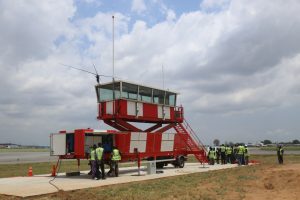
This modernisation, according to him, reduces the operational risk for international lessors and makes the acquisition of new aircraft for Nigerian carriers a safer investment.
Google+