- Achimugu's Latest Award: A Plus for NCAA, Nigerian Aviation
- Airlines to adjust schedules, divert to P'H, Enugu as FAAN shut Owerri Airport for runway repair work
- Air Peace takes delivery of E190 jet, breaks tradition on aircraft naming
- How mountain of debt is ‘grounding’ Nigeria’s aviation
- Lagos light rail to connect MMIA directly to Marina, city center, FAAN, CCECC mark landside concrete work completion



Anatomy of an avoidable crash: How cockpit compromise, infrastructure gap, exe. PR nearly cost 68 lives in Benin

The Nigerian aviation industry has once again stared into the abyss and walked away on the wings of pure luck.

The Nigerian Safety Investigation Bureau’s (NSIB) preliminary report into the July 23, 2026 runway excursion of an Enugu Air Embraer ERJ 170-100LR (5N-ENR) at Benin Airport exposes an alarming reality: when operational indiscipline in the cockpit meets infrastructural neglect on the ground, catastrophe becomes a mathematical certainty.
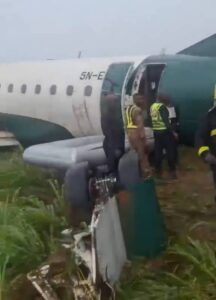
While all 68 passengers and crew evacuated unhurt, this incident demands ruthless dissection. It lays bare the persistent decay of aeronautical decision-making, regulator lethargy, and an institutional impulse toward corporate deflection when safety fails.
The Cockpit: A Cascade of Unforced Errors
Operating Flight ENU4264 from Lagos to Benin, the flight crew encountered an active convective front with moderate rain, surface water, and visibility down to 1,500 meters. Air traffic controllers explicitly advised that Runway 23 offered far superior weather vectors.
Yet, the crew opted for an Area Navigation (RNAV) approach to Runway 05. That single decision triggered a disastrous chain of events such as:
- Tailwind Penalty: The choice locked the jet into a 12-knot tailwind over the threshold, with the wind still blowing at over 6 knots upon contact, inflating ground speed and reducing braking efficiency.
- A Fatal Touchdown Point: Benin features a 2,400-meter paved runway. The Flight Data Recorder (FDR) revealed that the aircraft touched down at an astonishing 1,641.5 meters down the strip. The crew squandered over two-thirds of the runway, leaving less than 760 meters a mere 30% of asphalt—to stop a 35-tonne airliner on standing water.
- Deferred Defect Trap: The aircraft had been dispatched with its automated braking system unserviceable under the Minimum Equipment List (MEL). While lawful on paper for dry dispatch, executing a manual landing deep down a slick runway with an active tailwind eliminated all margins for error.
At a touchdown groundspeed of 138.2 knots and only 758 meters remaining, the laws of physics took over.
Why the flight crew refused to execute a mandatory go-around the moment the jet floated past the touchdown zone points to an alarming breakdown in Crew Resource Management (CRM).
The Aerodrome: Concrete Traps in Safety Areas
If cockpit judgment sparked the incident, aerodrome infrastructure transformed an overrun into a near-fatal impact.
After exhausting Runway 05, the Embraer rolled 325 meters into the unpaved overrun zone. There, it violently struck two decommissioned solid concrete localiser bases and airfield lighting fixtures, ripping through its nose landing gear, forward fuselage, and underside.
Under International Civil Aviation Organisation (ICAO) Annex 14 standards, Runway End Safety Areas (RESA) must be clear, graded, and devoid of rigid obstacles to decelerate aircraft safely.
Leaving unyielding concrete pedestals inside a runway strip turns an overrun into a high-impact event capable of rupturing fuel tanks and triggering post-crash infernos.
Compounding the hazard, unserviceable tower weather instruments prevented the seamless transmission of dynamic wind vectors, while physical obstructions blocked the control tower’s direct line of sight to the rollout zone.
The Executive Spin: PR Over Professional Accountability
Within hours of the hull coming to rest in the mud, airline management launched a masterclass in corporate deflection. Managing Director and CEO Captain Tolu Ita framed the crash as an unpredictable “hydroplaning event” and an act of adverse weather skillfully handled by the crew.
Behind closed doors, executive desks already held the Quick Access Recorder (QAR) telemetry. They knew the approach was unstable, the tailwind ignored, the touchdown egregiously late, and the autobrake dead. Yet public statements leaned heavily on FAAN’s ground equipment failures to paint the carrier as a victim of poor infrastructure rather than the author of an unstable approach.
The Bottom Line
Aviation safety requires flight operations and aerodrome safety nets to backstop one another. In Benin, both failed simultaneously. The Nigeria Civil Aviation Authority (NCAA), the Federal Airports Authority of Nigeria (FAAN), and airline boardrooms must act decisively on NSIB recommendations A-2026-039 through A-2026-042.

Next time, 68 souls may not be lucky enough to walk away from a preventable disaster.
Google+
It’s a stark reminder of how vulnerable safety can be when systems fail across multiple layers. The connection between the aircraft and the airport’s condition is really key to understanding what happened.