- Delta Air Lines to resume seasonal nonstop Lagos–New York flights Dec 2
- Tale of Two Skies: US commits $31b to fix ageing airspace, Nigeria gasps for funds
- Oyedele, Okonkwo task airlines, public institutions, say truth inflicts less damage than cover-up
- FG Introduces VPASS to strengthen airport security, passenger identification
- NSIB: Pressurisation anomaly preceded mid-air door separation on Triton Aviation jet



Oyedele, Okonkwo task airlines, public institutions, say truth inflicts less damage than cover-up
- ‘How weather cover-up worsened our Asaba flight mix-up’
Executive Chairman of United Nigeria Airlines (UNA), Prof. Obiora Okonkwo, has declared that radical honesty rather than spin or concealment is the most effective reputation management strategy for airlines and corporate organisations navigating operational disruptions.
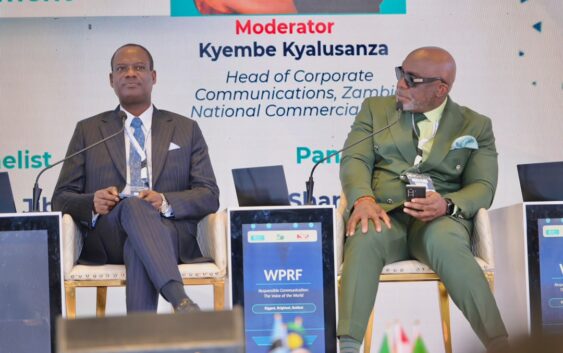
Speaking on Tuesday in Abuja during a high-level dialogue on Responsible Business Communication: Building Trust and Financing Investments for Sustainable Human Development at the 2026 World Public Relations Forum (WPRF), Okonkwo warned that attempting to massage facts during a crisis inevitably inflicts greater reputational damage than the original incident.

According to the airline boss, communicating verified facts shows respect for passengers and stakeholders, no matter how uncomfortable those realities may be.
Using his own carrier as a candid case study, Okonkwo revisited the widely publicised incident in which a United Nigeria Airlines flight bound for Abuja landed in Asaba instead.
He explained that the mix-up stemmed from a dispatcher’s documentation error, which mistakenly listed Asaba as the destination.
While the flight crew executed the flight plan as filed and the cabin crew mistakenly welcomed passengers to the Federal Capital Territory upon touchdown, Okonkwo noted that the operational error was manageable until the airline’s communications team tried to cover it up by blaming inclement weather in Abuja.
“Organisations must not confuse reputation protection with withholding or manipulating facts,” Okonkwo cautioned, noting that the inaccurate weather excuse compounded the fallout.
Okonkwo also shared a recent encounter highlighting the delicate expectations of Nigerian air travellers, revealing that a passenger vowed never to fly UNA again because a flight scheduled for 11:30 a.m. departed 10 minutes early at 11:20 a.m.
“A typical Nigerian traveller has his mind set on the timely departure of the airline, and if anything happens, you have to communicate the truth. You may have an AOG (Aircraft on Ground), technical issues, and sometimes that message doesn’t really sink,” he said.
Recalling his initial frustration at the passenger’s complaint, Okonkwo added: “I wanted to get angry; I wanted to shout back at him. But again, my experience being a member of this forum came into play, and I simply sent him a message saying, ‘I apologise for United Nigeria Airline leaving on time.’ That was my answer. He never got back.”
The UNA Chairman stressed that crisis communication cannot be outsourced entirely to corporate affairs units, insisting that top executives must take collective ownership when operational challenges arise.
“When there is a crisis, and there is a need for proper communication, leadership quality is also called into question. It becomes a collective responsibility of leadership,” he stated.
He urged airlines and service providers to deploy every available touchpoint—from airport flight information displays to digital platforms and social media—to keep travellers updated in real time, particularly during industrial actions or safety-related delays.
“Do you have a strike? Announce that you have a strike. That’s why we are disrupting our services. Do you have a safety issue? Announce!” Okonkwo charged.
Also speaking at the session, the Minister of Finance and Coordinating Minister of the Economy, Taiwo Oyedele, underscored the importance of predictability in public and corporate institutions, noting that deviations from communicated timelines—even seemingly positive ones—require clear explanation.
“Sometimes building trust requires that you be on time, not earlier and not later. And if you go earlier than you communicated previously, you must explain,” Oyedele said.
Drawing a parallel to public finance management, the minister observed that revenue-generating agencies under his ministry occasionally surpass their targets without explaining the variance.
“I need to know whether your 10 was too conservative. Maybe it should have been 15. I also need to know whether this extra 2 is sustainable or whether it’s one-off,” he explained.
The panel session, moderated by Kyembe Kyalusanza, Head of Corporate Communications at Zambia National Commercial Bank (Zanaco), also featured Edith Jibunoh, Director of External Affairs at the World Bank Group, and Sharon Ezzeldin, founder of Honour Public Relations in the United Kingdom.
Google+
