- United Nigeria Airlines unveils fleet despite harsh economic realities
- Benue Boat Mishap: NSIB Chief Leads Safety Assessment Team to Wadata
- ValueJet Reaffirms Safety Commitment as Engineers Commence Intensive Boeing Training
- African Ministers Adopt Lomé Declaration, Implement Matrix to Accelerate Accessible, Connected, Affordable Sustainable Air Transport
- Flight is an Organised Achievement



United Nigeria Airlines unveils fleet despite harsh economic realities

· Keyamo declares state-backed airline ‘bottomless pit’
· Names airplanes after Achebe, Obi of Onitsha

Today was a historic day as Nigeria’s flag carrier, United Nigeria Airlines, unveiled two newly acquired Boeing 737-800 NG aircraft.
Registered as 5N-CFC and 5N-CFB, these narrow-body jets represented a massive leap in capacity for the carrier. More than just machines, they were christened as flying monuments to Nigerian legacy.

One bore the name of His Royal Majesty, Igwe Nnaemeka Achebe, the Obi of Onitsha; the other honoured the late literary titan, Professor Chinua Achebe.
Dignitaries, including the Minister of Aviation and Aerospace Development, Festus Keyamo, and the Obi of Onitsha himself, watched as the ribbon was cut.
The airline’s Chairman, Prof. Obiora Okonkwo, and Chief Commercial Officer, Adedayo Olawuyi, spoke of a “defining chapter” aimed at connecting regional routes and bringing premium comfort to passengers.
Okonkwo said the airline deliberately chose names that reflect lasting contributions to Nigeria and Africa.
“Today, we are gathered here not only to celebrate aviation but also to honour legacy, leadership and excellence,” he said.
“Behind me today are two giants. These two aircraft bear the names of two extraordinary men whose contributions have shaped our society in profound ways.”
Yet, beneath the celebratory applause and the jet-engine hum lay a deeper truth: flying in Nigeria is a high-stakes gamble against harsh economic realities.
While the arrival of new aircraft is a victory, domestic airlines operate in one of the world’s most turbulent aviation environments. As Prof. Okonkwo noted during the ceremony, the cost of doing business is actively eroding the competitiveness of local carriers.
Aviation Minister Festus Keyamo explicitly ruled out the creation of a government-funded national carrier, calling it a “bottomless pit.”
Instead, the federal government is shifting its focus toward empowering privately owned indigenous airlines such as Air Peace and United Nigeria Airlines by improving their access to international routes and to fairer financing models.
Speaking at the event, the Obi of Onitsha described the honour as both personal and deeply meaningful. He said he was particularly delighted because one aircraft bears the name of his longtime friend and kinsman, Chinua Achebe.
“I am deeply honoured by this recognition and by the decision of United Nigeria Airlines to name one of its aircraft after me,” the monarch said.
“But I must also say that I am especially pleased because the other aircraft bears the name of my kinsman and dear friend, the late Professor Chinua Achebe.”
The monarch reflected on his relationship with the celebrated author and the global impact of Achebe’s literary works. According to him, the Achebe legacy continues to influence generations across continents.
“Chinua Achebe was not only one of Africa’s greatest literary icons; he was a man whose work gave voice to our people and projected African stories to the rest of the world,” he said.
“His legacy continues to inspire generations across the globe.”
The Obi recalled travelling abroad and meeting people who immediately associated Onitsha with Chinua Achebe. He noted that the author’s influence stretched far beyond Nigeria’s borders.
“I recall occasions when people who knew I was from Onitsha would immediately ask me about Chinua Achebe. His influence reached far beyond Nigeria, and he remained one of the most recognised and respected Africans of our time.”
He added that Achebe’s books played a major role in shaping global understanding of Africa and its people.
“I remember visiting different parts of the world and encountering people who had read his works. His books opened doors for many of us and helped shape global understanding of Africa and its people.”
For the monarch, seeing the Achebe name on an aircraft represents more than recognition. It is a reminder of values that continue to inspire society.
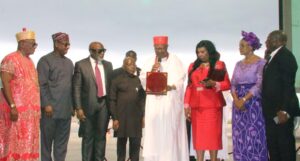
“To have an aircraft named after Chinua Achebe and another named after me is both humbling and deeply symbolic,” he said.
“This gesture is not just about individuals; it is about celebrating excellence, service, leadership and the values that continue to inspire our society.”
Google+