- NAMA responds to alleged rot, 'wasted' ILS
- Ghana envoy lauds United Nigeria Airlines, seeks deeper aviation ties
- Leadway unveils short-term 'Arrival Pack' to target Nigeria's peak seasonal travel
- Nigeria Aviation: The Boiling Pot
- Beautiful flower in wrong soil: How incompatible airfield lighting rendered Lagos CAT 3 ILS unusable



‘Why Nigeria Is Missing Out As Africa’s Aviation Powerhouse’

…seeks unified African sky
The Director-General of the International Air Transport Association (IATA), Willie Walsh, said Nigeria should be a powerful aviation market, given the country’s population and underlying wealth.

Walsh, who spoke to Aviation Metric on Monday on the sidelines of the 82nd International Air Transport Association (IATA) Annual General Meeting (AGM) and World Air Transport Summit in Rio de Janeiro, Brazil, said there’s no reason why it shouldn’t.
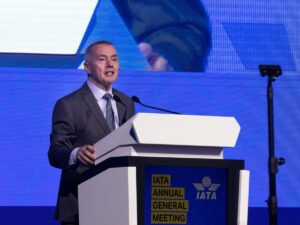 Walsh
Walsh
Walsh disclosed that Africa represented one of the world’s most compelling long-term aviation growth frontiers, yet faces persistent financial and operational headwinds that cap its short-term profitability.
He said: “The problem there is, you know, the infrastructure has not developed at the pace it should have.
But it’s principally down to the cost of operating in Nigeria and the uncertainty that that brings into the market.”
While modernisation plans— such as the major N712 billion reconstruction project for Murtala Muhammed International Airport (MMIA) Terminal 1—signal the right intentions, airport capacity constraints, ageing terminals, and suboptimal ground logistics continue to strain operations.
The IATA DG further stated that Africa would never reach its full potential unless it adopts the Single African Air Transport Market (SAATM). He said: “Like we are looking at 10 per cent growth in Africa this year, which is very encouraging, because, as you know, a lot of traffic from Africa goes over the Middle East. A lot of traffic from Africa to Africa goes over the Middle East, which is bizarre.
“The fact that to connect within the continent, you’re flying outside the continent. That shouldn’t happen. But it will continue to happen until we make it easier for airlines to connect internally. And the best way to do that is to provide greater freedom for airlines to operate across the African continent, rather than continuing to operate as we have for many years.
“Right now, the African aviation landscape is one of the most expensive and fragmented in the world. When governments restrict access to protect struggling state-owned or domestic carriers, they actively deny their own markets the benefits of economies of scale.”
Walsh frequently points to the European “Open Skies” model as the blueprint: full liberalisation doesn’t destroy local industries; it creates a massive, unified sandbox that lowers operating costs, drives down ticket prices, and gives consumers more choices.
SAATM, launched by the African Union in 2018 as a flagship project of Agenda 2063, is designed to fully operationalise the 1999 Yamoussoukro Decision. Its ultimate goal is to completely transform African aviation from a fragmented network of highly restrictive bilateral agreements into a unified, deregulated open sky.
Crucially, it guarantees the fifth freedom right, allowing an eligible African carrier to fly between two other African nations on a route that originates or terminates in its home country, such as an airline operating Lagos–Nairobi–Cairo, with the right to pick up and drop off passengers in Nairobi.
While SAATM currently has the political commitment of nearly 40 African nations (representing over 80% of intra-African traffic), the main hurdle remains moving from signature to implementation
Google+