- Aisuebeogun at summit: Why Nigeria needs resilient transport system to survive external shocks
- Babalakin lauds Tinubu over 19 years BASL, FG dispute resolution, pledges mass job creation
- Air Peace strengthens leadership pipeline with key flight operations appointments
- Transport Summit Holds Friday
- What Abuja private jet door blowout reveals about aviation safety



Nigeria Airlines Spend N6.3bn On Offshore Pilot Training
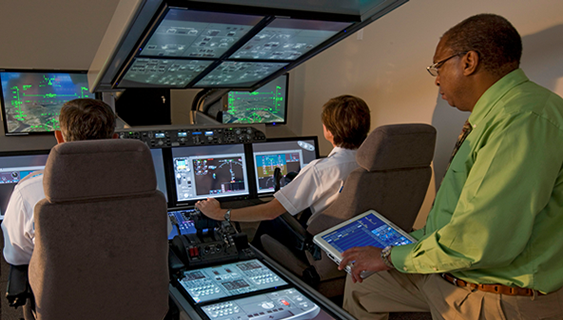
Nigeria spends a whooping N6.3 billion annually to have her crew go for recurrent pilots’ training overseas, WoleshadareNews has learnt. This, according to a 2014 report published by the Federal Government, is because of lack of simulator aircraft to train Nigerian pilots locally.
It has been ascertained that an airline with four aircraft spends at least $600,000 on simulator training for its pilots.

This means that the airline spends $150,000 on pilot training for each aircraft. Consequently, major airlines spend $8.3 million (N1.25 billion) every six months, and $16.7 million (N6.4 billion) every year.
Flight simulation reduces significantly the cost of flight crew training. The Federal Government had, in 2014, said it would purchase full Jet- Flight Simulators (5000 Series B737) to be located at the Murtala Mohammed International Airport, Lagos.
But as lofty as the proposal appears, two years after the contract was awarded, not much has been achieved to install the facility.
Also, many domestic airlines’ pilots are reluctant to use the facility. Reason: they earn allowance in foreign currency when their employers send them out for training.
Having such facility in Nigeria would put an end to such funds. Former Minister of Aviation, Chief Osita Chidoka, said the contract, which had been awarded to Messrs CAE of Canada, would cost $21.459 million, stressing that the project was expected to be completed within 24 months.
He stated that the venture would serve as a source of revenue generation for the country, but that has not materialised as there are no signs of the multi-billion naira Jet- Flight Simulators arriving for installation more than two years after Chidoka made the disclosure.
Proficiency, rather than hours logged, is a primary and essential ingredient in air safety. Many pilots seem to view recurrent training such as a Flight Review (FAR 61.56), or the Instrument Proficiency Check (FAR 61.57d), as the only training they perform after receiving their last rating.
Routine flights do not prepare a pilot for unusual situations, whether there are unexpected crosswinds or systems/engine anomalies.
Professional pilots receive regular recurrent training to include emergency procedures whether they fly as an astronaut, an airline pilot, a military pilot, a law enforcement pilot, an EMS, charter or corporate pilot.
Some of their training is United States Federal Aviation Administration (FAA) mandated, some company mandated or pilot requested. Professional pilots’ recurrent training is a vital factor in safe aircraft operations.
The professional pilots’ periodic training is required to enhance their aviation knowledge and skills, train on new equipment or avionics, learn new and revised regulations and procedures, and ensure a certain level of proficiency is present. Most of these pilots receive training at least once every six months.
There are indications that cost could be as high as N10 billion annually owing to the dwindling fortune of the naira, which has made flights to be on the high side, including having to pay to the institution where the trainings are conducted in dollars.
Recurrent training is so important that some insurance underwriters offer up to 7.5 per cent premium credit for qualified annual recurrent training.
An aircraft pilot and aviation safety advocate, Capt. Dung Rwang Pam, said that N6.3 billion spent on training abroad annually would have been able to build type rating training organisation in Nigeria.
Pam lamented that the government was negligent in not planning for the future to curtail capital flight.
He equally berated the government for not having aircraft maintenance facility in the country, stressing that Nigeria cannot have a national carrier without a maintenance base. Pam blamed airlines, which are in dire strait, for their woes.
His words: “First of all, I will blame the airlines themselves. They submitted a business plan, which I assume they did and the business plan spelt out exactly how the business is going to be run. Running the business involves keeping maintenance reserve so that you can do your check.”
“Many times, you are expected to lease another aircraft for the one week or two weeks the aircraft has gone for that C-Check. That is a stopgap measure. The aircraft returns from C-check and you continue operations seamless without anybody knowing.
How many times have you heard foreign airlines ground their operations because of maintenance? I would like to add this. The government is complacent on this matter; I won’t say the Nigerian Civil Aviation Authority (NCAA).”
He noted that even the maintenance reserve would not have seen them through because forex had doubled.
Google+
