- IATA raises alarm as airline payment processing costs surge to $24.5 billion
- Breaking the 19-Year Jinx: How MMA2 resolution reclaimed Nigeria’s aviation PPP future
- UK carriers hit Nigeria flight ceiling, can’t expand operations without regulatory review
- Tinubu appoints Keyamo to lead APC air mobilisation directorate, Farouk Umar, Kuku as dep. directors
- Dawodu tasks aviation sector on bridging skill gaps for Next-Gen professionals



IATA urges global support for CORSIA as aviation carbon scheme hits 10-year mark
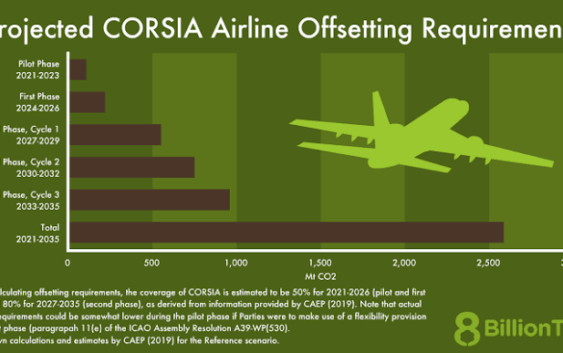
The International Air Transport Association (IATA) has called on governments worldwide to strengthen the foundations of the Carbon Offsetting and Reduction Scheme for International Aviation (CORSIA) as the landmark decarbonization framework marks its tenth anniversary.
Adopted at the 2016 International Civil Aviation Organisation (ICAO) Assembly, CORSIA is the first global market-based measure for an industrial sector and a critical follow-up to the 2015 Paris Agreement.


More than 130 countries currently participate in CORSIA, which is expected to mitigate roughly 200 million tonnes of $\text{CO}_2$ by the end of this year.
By 2027, the scheme is projected to cover 85% of global aviation emissions and could mobilise up to $120 billion in climate finance for emissions-reduction and carbon-removal projects throughout its lifecycle.
Speaking on the milestone, Marie Owens Thomsen, IATA’s Senior Vice President Sustainability and Chief Economist, highlighted the framework’s role in international cooperation.
“As the first global, sector-wide climate agreement for aviation, CORSIA showcases the best of international collaboration: a global solution to a global challenge,” Thomsen said.
“It preserves a level playing field for aviation while channelling climate finance to support emissions reductions around the world. In a world increasingly characterised by fragmentation, that is a powerful reminder of what can be achieved when states work together.”
Thomsen added that with broad participation, consistent implementation, and sustained government backing, CORSIA can become “one of the most successful examples of climate action and climate finance in practice.”
The anniversary comes as the European Union reviews its Emissions Trading System (EU ETS). Proposed reforms under consideration could extend the EU ETS to destinations within 5,000 km of Frankfurt and establish a mechanism to develop carbon-pricing systems with third countries.
IATA expressed strong reservations about the proposals, warning that expanding the EU ETS extra-territorially risks undermining the global framework.
Thomas Reynaert, IATA’s Senior Vice President External Affairs, cautioned against regional duplication.
“The EU ETS review should reinforce CORSIA as the global framework for international aviation, not encourage overlapping regional or bilateral systems,” Reynaert noted. “Europe will achieve more for climate action and its own competitiveness by directing aviation revenues towards Sustainable Aviation Fuels, infrastructure, and emerging technologies than by adding carbon costs that do not address the sector’s underlying energy constraints.”
IATA also pointed out the absence of a comprehensive impact assessment on the proposed EU ETS expansion.
The airline body warned that widening the scope could increase EU ETS compliance costs by 40%—totalling €280 billion between 2027 and 2040—while disrupting international connectivity, competitiveness, and CORSIA’s overall effectiveness.
To accelerate decarbonization while safeguarding competitiveness and energy security, IATA urged EU policymakers to focus on three core areas: ensuring full implementation of CORSIA for international aviation without extra-territorial extension of the EU ETS; removing the proposed “EU ETS as a Service” mechanism to avoid parallel regional carbon-pricing systems; and strengthening the Sustainable Aviation Fuel (SAF) allowances mechanism by providing immediate support before 2029 and eliminating geographic restrictions that limit support for compliant SAF pathways.
Google+