- Lagos airport reconstruction, light rail project hit ₦1 trillion investment portfolio
- Kila Debunks ‘Fake Professorship’ Claims, Moves to Court
- FAAN sparks Next-Gen interest with NYSC, high school aviation career programme
- FAAN targets seamless travel at MMIA with Biometric gates, digital upgrades
- United Nigeria Airlines headlines 2026 Ndigboamaka traders cup



Lagos airport reconstruction, light rail project hit ₦1 trillion investment portfolio
- How Nigeria’s oldest airline, Aero Contractors rebounded from -134% Margin
In a major push to modernise Nigeria’s critical transport infrastructure, the Federal Government has revealed an investment portfolio exceeding ₦1 trillion to overhaul Murtala Muhammed International Airport (MMIA), Lagos, and build a connecting light rail system.
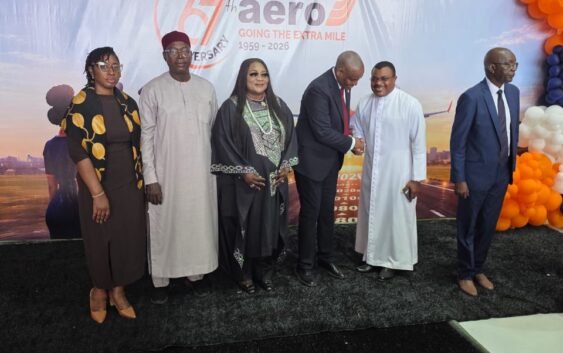
The Minister of Aviation and Aerospace Development, Festus Keyamo (SAN), disclosed this during a ceremony celebrating the 67th anniversary of Aero Contractors, Nigeria’s oldest surviving airline.


Breaking down the landmark projects, Keyamo said the ongoing reconstruction of the Lagos airport carries a price tag of ₦712 billion.
This is complemented by a forthcoming light rail project designed to link the Ikeja bus terminus directly to the airport’s domestic (MMA2) and international wings.
According to the Minister, funding for these ambitious civil works stems directly from the federal government’s fuel subsidy removal, which has freed up capital to turn airports across the country into active construction zones under President Bola Tinubu’s Renewed Hope Agenda.
He noted that the Lagos airport project alone has already generated over 2,000 local construction jobs.
Highlighting the economic toll of delayed infrastructure, Keyamo cited the long-awaited second runway for Nnamdi Azikiwe International Airport in Abuja.
Originally costed at ₦40 billion nearly two decades ago, the project’s valuation has surged past ₦400 billion—a stark reminder, he noted, of how capital project delays penalise the national treasury.
Turning his focus to the host of the anniversary event, Keyamo lauded Aero Contractors for its extraordinary endurance in an industry notorious for high mortality rates. After assuming office, the Minister ordered an audit of Nigerian carriers and found that over 100 airlines had folded in recent decades.
“Aero has survived through the storm at a period when we have witnessed over 100 airlines go under,” Keyamo declared.
“That is how high the mortality rate is in Nigerian aviation, and here we are today celebrating Aero Contractors. The airline has survived through resilience. Other airline CEOs should come and learn from them; this is a story of success.”
Tracing the airline’s storied journey, Aero Contractors’ Managing Director, Capt. Ado Sanusi, detailed its evolution from a modest 1959 charter and crop-spraying operation into a cornerstone of West African aviation.
Initially built on rotary-wing operations ferrying personnel and heavy equipment to offshore oil fields in the Niger Delta, Aero launched scheduled commercial passenger flights in 2000 and eventually solidified its position as the country’s longest-serving scheduled carrier.
Sanusi acknowledged the severe financial distress that nearly doomed the airline, culminating in an intervention by the Asset Management Corporation of Nigeria (AMCON) in 2016, which took a majority stake to stabilize the firm.
“I came to tell you a story of resilience,” Sanusi reflected. “We have grounded fleets and empty hangars, and still, we flew. We have gone months without a single aircraft in the sky, and still, we flew. We have buried colleagues, gone without pay, and watched the world write us off, and still, we flew.”
That perseverance is now yielding tangible financial turnarounds. Sanusi disclosed that Aero shifted from a grim operating margin of -134% in 2022 to a positive operating margin by 2025.
Beyond passenger haulage, Aero has become an indispensable regional maintenance hub. On January 4, 2018, the airline made aviation history in West and Central Africa by conducting the region’s first indigenous C-check on a Boeing 737 aircraft at its Ikeja hangar—ending a 14-year drought where no local carrier could perform such heavy maintenance in-country.
Today, Aero operates as a fully integrated aviation enterprise spanning scheduled flights, offshore rotary support, pilot training, and a state-of-the-art Maintenance, Repair, and Overhaul (MRO) facility equipped with smart tooling to serve domestic and regional carriers.
