- Ibom Air's dominance or protectionism? High-stakes battle for Uyo’s air routes
- FAAN resolves airport transit crisis, apologises to passengers, approves Bolt operations
- Anatomy of an avoidable crash: How cockpit compromise, infrastructure gap, exe. PR nearly cost 68 lives in Benin
- African airlines trapped in uncomfortable expansion cycle
- NSIB has no mandate to bring down airlines, we follow the facts-Badeh Jr



Ibom Air’s dominance or protectionism? High-stakes battle for Uyo’s air routes

The issue of Ibom Air’s dominant market position on the Uyo–Abuja (QUO–ABV) and Uyo–Lagos (QUO–LOS) routes sits at the intersection of economic competition theory and practical commercial strategy in Nigerian civil aviation.

Whether this concentration of market share represents healthy, structural competition or predatory market strangulation depends on whether it is viewed through the lens of operational economics or consumer accessibility.

The debate around route monopolies, home-base dominance, and carrier protectionism highlights a major structural shift in Nigerian domestic and regional aviation.
The Argument for “Strangulating” Competition: Market Barriers
Conversely, critics and consumer advocacy groups contend that Ibom Air’s market concentration produces effects akin to a natural monopoly, creating significant barriers to entry for rival carriers.
They contend that high localised demand on the Uyo–Abuja and Uyo–Lagos routes, coupled with limited continuous capacity from rival carriers, allows for aggressive yield management.
Peak fares into Uyo often exceed those on multi-carrier trunk routes of equivalent distance, leading travellers to argue that the lack of sustained multi-carrier presence inflates base fares.
There is an argument that when competing operators (such as Air Peace or United Nigeria) schedule flights to Uyo, Ibom Air can leverage its Uyo-based fleet to add frequency around rival flights.
Some said this slot-frequency advantage suppresses competitors’ load factors, making the route commercially unviable for new entrants seeking to build operational scale.
Independent commercial airlines argue that state-backed carriers operate with an implicit financial safety net for capital expenditure, access to airport infrastructure, and tax offsets, creating an uneven playing field for purely private operators.
At the heart of this discussion is Ibom Air, owned by the Akwa Ibom State Government, which has systematically moved to establish Victor Attah International Airport (QUO) in Uyo as a sub-regional hub.
Clarifying the “Monopoly” vs “Dominance” Narrative
Critics often cite Ibom Air’s commanding presence on routes such as Uyo–Lagos, Uyo–Abuja, and Uyo–Accra as evidence of a regional monopoly. However, operational context and regulatory clarifications highlight key market realities, such as De Facto Hub Dominance and Not a Statutory Monopoly.
Nigerian Civil Aviation Authority (NCAA) regulations do not grant exclusive route monopolies on domestic trunk paths. Ibom Air’s high market share in Uyo stems from first-mover advantages, dedicated home-base infrastructure, and schedule integrity rather than regulatory foreclosure.
Until now, domestic competitors such as Air Peace and Dana Air historically have maintained operating rights into Uyo. However, secondary carriers often struggle to match Ibom Air’s frequency, fleet utilisation (CRJ-900s and Airbus A220s), and localised ground-handling efficiency.
Historically, Nigerian aviation centred almost entirely on the Lagos–Abuja corridor. Ibom Air’s hub-and-spoke model proves that secondary regional airports can capture significant origin-and-destination (O&D) traffic if backed by institutional commitment.
High demand for Uyo flights combined with Ibom Air’s high load factors has driven yield expansion. While competitors accuse the carrier of yield-locking the route, market entry remains open to any Nigerian AOC holder that can meet the slot requirements.
Ibom Air’s trajectory serves as a case study for state-backed airline initiatives in Africa, demonstrating how long-term capital allocation to airport infrastructure yields sustained capture of the commercial market.
Unlike competing domestic carriers that historically deployed larger 130–150+ seat aircraft (such as Boeing 737s) onto regional routes, Ibom Air launched with right-sized Bombardier CRJ-900 jets (approx. 90 seats) and introduced fuel-efficient Airbus A220-300s.
This offers lower trip costs, higher seat-occupancy ratios, and flexibility to scale frequencies rather than dumping unprofitable seat capacity.
Private airlines contend that state ownership grants Ibom Air an uneven playing field. Capital expenditures such as terminal facility access, aircraft pre-delivery financing support, and local infrastructure backing are backed by the state government.
This enables the carrier to absorb market volatility and FX shocks better than balance-sheet-constrained private operators.
Last line
Ibom Air’s control of the Uyo–Abuja corridor is a result of commercial execution and structural hub dominance rather than regulatory foreclosure.
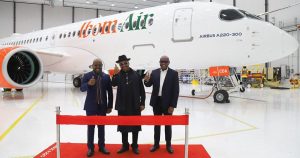
While the carrier does not breach NCAA regulations regarding route access, its high frequency, fleet efficiency, and localised infrastructure create market dynamics that make sustained competition financially difficult for secondary carriers.
Google+