- Iyayi: Communication gaps, inadequate facilities behind airlines' delay crisis
- Part 2: Apologies for the Delay, Rethinking Culture of Late, Postponed, Cancelled Flights in Nigeria
- Enugu Air to launch regional route to Douala Sept 23
- SAA wins top African airline award at travel market
- Airlines debt crisis triggers safety concerns, Bernard urges NCAA financial audit



Airline operators beg FG to suspend charges to ease cash flow

- Deny debt claim, seek TSC, CSC abolition
The Airline Operators of Nigeria (AON) has appealed to the Federal Government for a temporary suspension of statutory charges to ease cash flow challenges, citing the Iran-Israel/United States conflict as one of the factors worsening operational costs globally.
AON’s argument is that they aren’t trying to rob the government; they are simply trapped in an unprecedented liquidity squeeze.

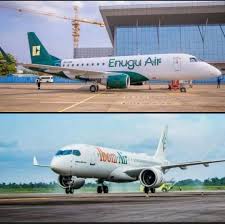
This comes as the carriers denied claims that they owe the Nigeria Civil Aviation Authority (NCAA) a humongous amount of money in unremitted Ticket Sales Charge (TSC) and Cargo Sales Charge (CSC), insisting that all cost recovery services provided by the regulator are fully paid in advance.
When cash flow is that tight, holding onto those collected funds becomes a matter of survival just to keep the planes fueled and flying today, even if it creates a regulatory headache tomorrow.
It is a high-stakes game of chicken: if the government doesn’t ease the charges, airlines might collapse; if the government does, the safety oversight system loses its teeth.
The position emerged as a follow-up to the NCAA’s recent suspension of its cost-recovery directive against airlines for outstanding Ticket Sales Charges and Cargo Sales Charges.
However, the AON argued that the public narrative surrounding the dispute wrongly suggests airlines receive unpaid regulatory services from the Authority.
According to the airline body, every cost recovery obligation imposed by the NCAA operates strictly on a cash-before-service basis.
The association stated that no airline receives approvals, inspections, licence validations, or documentation renewals without full payment.
“The AON wishes to make it clear that all cost recovery services rendered by the NCAA to domestic airline operators are paid for fully in advance on a cash-before-service basis,” the association said.
The group explained that the NCAA issues invoices for every regulatory activity performed for airlines. Operators are then required to settle those invoices completely before the Authority proceeds with any service delivery.
“In practice, no domestic airline in Nigeria receives NCAA regulatory services without first making the full payment of invoices issued to it by the NCAA,” AON added.
The association maintained that the so-called outstanding debts referenced by the NCAA relate solely to the controversial 5 per cent Ticket Sales Charge (TSC) and Cargo Sales Charge (CSC), which airlines collect from passengers on behalf of the aviation system.
According to AON, the charges are entirely separate from cost recovery payments for regulatory services rendered by the airlines.
The airline operators argued that the current debate centres on tax collection rather than on unpaid regulatory services. They stressed that domestic airlines, beyond remitting the 5 per cent TSC, still pay directly for services offered by aviation agencies.
“Domestic airlines, in addition to this 5% TSC, still pay separately and directly for services provided by the various industry agencies, including the NCAA itself,” the association stated.
The AON further criticised attempts to portray the NCAA as a revenue-generating agency rather than a safety regulator. According to the group, international aviation standards support a cost-recovery structure rather than excessive taxation on operators.
“The NCAA is a regulatory body, not a revenue-generating agency,” the association declared.
Meanwhile, the body disclosed that several airlines had previously maintained dedicated accounts from which the NCAA automatically drew monthly remittances.
However, worsening financial pressures caused by rising Jet A1 prices and global geopolitical tensions reportedly disrupted those arrangements.
The association cited the Iran-Israel/United States conflict as one of the factors worsening operational costs globally.
President Bola Ahmed Tinubu later approved a 30 per cent concession on outstanding obligations owed by airlines to aviation agencies.
The AON acknowledged the intervention but said that broader relief measures remain necessary for the industry’s survival.
The association also revisited the origins of the 5 per cent TSC, tracing its introduction to the administration of former Head of State, Yakubu Gowon, more than four decades ago.
According to the AON, the charge was originally introduced when the former Federal Civil Aviation Authority lacked adequate budgetary allocations to maintain newly built airports across the federation.
“The 5% Ticket Service Charge in question was introduced over 45 years ago under the Government of General Gowon,” the statement noted.
The group further argued that Nigeria Airways, which dominated domestic operations at the time, was exempted from the TSC arrangement, while foreign airlines bore the responsibility.
AON stated that the aviation sector has since evolved significantly, with multiple agencies now operating independently and imposing separate fees, levies, and taxes on domestic carriers.

The association alleged that, despite opposition from stakeholders, the TSC later found its way into aviation legislation and remained in force even after the sector’s deregulation in 1982.
Google+