- Walsh: It's bizarre that a lot of traffic from Africa to Africa goes over the Middle East
- IATA: 8,000 aircraft backlog holding back aviation
- United Nigeria to set up Air Bissau, national carrier for Guinea-Bissau, sign Mou
- Ibom Air transitions domestic flight operations to the new Uyo Int'l Airport terminal June 14
- Airlines' debts to ground handling firms piling up, AGHAN lifts suspension on Max Air



Aviation rot finds expression in airlines’ collapse
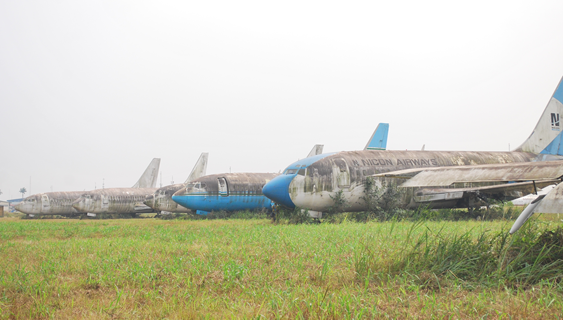
Economic recession, coupled with shortage of dollars, high costs and scarce fuel supplies has created a storm in the aviation industry, reports WOLE SHADARE
Nigerian airline business has come a long way and has faced a lot of challenges for survival.
For now, the country has eight airlines operating scheduled flights. They are Aero Contractors, Dana, Arik, Overland, Azman, FirstNation, Air Peace and Medview.
In spite of the seeming growth of the sector, Nigeria’s airlines have in some cases over reached themselves in borrowing while the high cost of operation has added to the woes of some of the operators.
Naïve airline owners often get carried away by such huge resources and start diverting funds to other businesses. The consequence of this is the collapse of the airlines.
Arik’s could be one of such. The carrier came with a lot of promise but ended up hanging precariously until the Assets Management Corporation of Nigeria (AMCON) came on rescue mission to save it from imminent collapse.


The Airline Operators of Nigeria, (AON) attributed the poor performance of domestic airlines to multiple taxes by various agencies in the aviation sector.
AON Chairman, Capt. Nogie Meggisson, lamented that the system had failed to recognise the pivotal role airlines could play in bringing the nation’s economy out of challenging times.
He said the system was continuously manipulating, feasting on and pushing the financial envelope of airlines by inflicting multiple taxes and levies to the extent that airlines are now groaning under the pressure and some are going bankrupt.
Meggisson said: “AON has been screaming and complaining about the same issue over the years that have culminated in sending over 27 airlines under in the past 25 years.
“A case in point is the recent takeover of Arik Air and Aero Contractors by AMCON in the face of huge financial burdens that have shown themselves as fallout of the multiple and sometimes unfair charges and taxes airlines are forced to grapple with on a daily basis.
“The Nigerian Civil Aviation Authority policy of levying operators flying on scheduled flights out of Nigeria is a punitive measure devoid of any economic sense to the airlines.
“The Federal Airports Authority of Nigeria charges the most expensive land rate in the world at N60, 000 per square metre. That is more expensive than choice land in Victoria Island, Lagos, and Asokoro in Abuja.”
Many industry observers believe this was what led to the demise of many indigenous carriers of such as Okada Air, Oriental airlines, Chanchangi, IRS, Discovery Air and Air Nigeria among others.
Nigeria has one of the highest number of domestic airlines registered, it is one of those that parade airlines with the shortest life span in the world.
In 2009, three airlines Bellview, Afri-jet Airlines and Capital Airlines had to shut their operations, and of those airlines remaining in the skies, few are without significant debts.
In May 2010, the government announced measures to prevent financial crisis in the industry.
The Central Bank of Nigeria made available a $3.3 billion fund to airlines, so that they could refinance their loans with the country’s banks and amortize them over a period of 10-15 years.
But these airlines die even before they pay back what they owe government.
The fund should stave off any further airline closures and allow the industry room to grow.
The rate at which Nigerian airlines come and go under is giving aviation stakeholders, experts and analysts a source of concern to the extent that they warned that if care is not taken the airline business in the country will collapse if these issues are not urgently addressed.
The carriers have been facing a lot of challenges in the course of their operations and these include high indebtedness to banks, aviation agencies and other entities, payment of charges to the various agencies, high cost of aviation fuel and absence of business model.
The high cost of aviation fuel also known as JET A1, which experts say cost airlines about 40 per cent of their income, has not only make the cost of operation high, it has also make it impossible for local airlines to break even.
Other challenges facing airlines are multiple entries granted to well-funded and efficiently managed international airlines by the Federal Government through the Ministry of Aviation, poor management, lack of enough aircraft in their fleet to operate their scheduled routes, lack of maintenance facilities in the country where domestic airlines can carry out major checks such as C and D instead of taking their aircraft abroad, inability to access funds for expansion of their airlines, double digit interest rate paid on loans from financial institutions, lack of feasibility study before embarking on airline business, lack of financial discipline, management indiscipline, introducing charges that cannot be explained and government policies, which often time somersault thereby affecting the operations of airlines.
These challenges are choking and have made Nigerians to set up airline business and aviation school in neigbhouring Ghana.
Though, some airlines are planning to commence airline business, there are indications that these same challenges facing those already operating may affect these potential new entrants.
Some of the stakeholders who spoke on the issue said that these challenges have not been addressed by successive governments, reminding the government that aviation industry must not be allowed to die.
Discovery Airways Limited started services and died few months after operation. Its demise is like many before and after it.
Managing Director of the airline, Capt. Abdul-Salami Mohammed believes that Nigerian domestic airline have short life span due to lack of proper planning and the harsh and non- conducive business environment.
He says harsh business environment makes it difficult for Nigerian operators to access long term credit facilities from financial institutions.
Mohammed argues that unlike in Europe and America, where there are finance companies that are willing to lease aircraft to operators, Nigeria is, however, seen as a high risk country and operators are therefore forced to pay upfront making them to grapple with limited resources.
He says that if there’s conducive atmosphere for airlines to operate and they get long term credit with single digit interest rate from financial institutions, domestic airline operations will thrive in the country.
A former Rector, Nigerian College of Aviation Technology (NCAT), Mrs. Folasade Odutola, says that apart from the airlines business that is not growing, the aviation industry is also not growing.
The one time Nigeria representative at International Civil Aviation Organisation (ICAO) says that the industry is not growing, as few aircraft are flying today compared to the 80s when Nigeria had over 100 aircraft operating in the domestic scene.
“I don’t think it has grown. You recall how many airlines we used to have in the past. How many do we have now? In 1984, we had over a 100 airplanes flying. Now, how many airlines are operating today? Then Nigeria Airways Limited (NAL) alone was flying so many routes and had more than 20 aircraft. So compare that with what we have on ground today.”
In a similar vein, the President of Nigerian Aviation Safety Initiative (NASI) and a United Kingdom-based aviation expert, Capt. Dung Rwang Pam, stated that most Nigerian domestic carriers go into airline business without proper planning, adding that as a result they do not know the financial implications and the human resources needed to grow the business.
He also argued that airline business in Nigeria was the way it is because the operators have failed to take into consideration the peculiarities in the environment in which they operate and the double digit interest rate charged on funds accessed by airlines from financial institutions.
Pam emphasised that one of the greatest challenges facing Nigeria domestic airlines in the country was managerial incompetence on the part of those managing airlines, adding in the Nigeria local airline scene, an incompetent owner often time overrule a competent management , who in turn ruin the business.
According to him, “Most airline operators enter the business without robust business plans. Consequently, they grossly underestimated the financial and human resources required to sustain the business.”
“They fail to consider the peculiarities of the Nigerian economic operating environment especially the persistent trend of double digit inflation and interest rates in excess of 20 per cent yearly.”
He stated that it flies in the face of reason why any serious entrepreneur will invest in a business that struggles to attain global profit margins of five per cent without diligent planning and careful implementation.
Most airline operators also underestimate the time it takes for route development and subsequent profitability. The final Achilles heel in the system is managerial incompetence.
In many instances, a competent management is often hijacked and overruled by an incompetent sole proprietor owner who then sadly ruins the business.
This explains why almost all Nigerian commercial airlines are trapped in a cycle of unsustainable debts culminating in short life expectancy. When this happens panic sets in and these airlines start to execute ruthless cost cutting measures leading to defaults in credit obligation, adding that it also lead to inability of airlines to fund scheduled operational costs such as aircraft lease payments required maintenance mandatory training, staff salaries and appropriate insurance cover.
President, Sabre, an aviation solution network, Gabriel Olowo, while speaking on the state of Nigerian airlines, said that domestic airlines operate both scheduled and non-scheduled flights and that these airlines are aware of this, adding that instead blame the regulator each time there is an accident.
This he said amount to merely attending to the symptoms of these problems and not the root cause.
He added that the regulator was to demand and ensure minimum standard while an enduring airline operates above the minimum.
He regretted that the Federal Government was not serious about proper diagnosis and adequate remedial treatment for the airlines persistent sickness.
The Sabre President said that one of the challenges airlines in the country have was the problem of management and liquidity, as they needed funds for fuelling, training, wages, routine maintenance and that these issues were crucial to their operations.
According to him, Nigerian Airlines do not earn enough to cover their cost. But shouldn’t government seriously address these cost issues if passengers are not to pay cut throat prices for flying? Previous attempts by government to address some of the issues are misconceived and ill advised.
Olowo contended that the intervention fund that was released by the Federal Government through the Central Bank ended up solving the problems facing banks not the airlines, as it further made airlines illiquid.
Federal Government, he said should reflect on areas such as fuel price, landing and parking fees, rent, over flight charges, duty waivers, vat waiver on air transport as it is on road, insurance indemnity, debt forgiveness, deliberate market shift through single entry point into a Nigerian gateway, voluntarily compulsory mergers and compulsory International Civil Aviation Organization (ICAO) Operational Safety Audit (IOSA) certification.
In the past 17 years, at least 141 airlines had closed shop in Nigeria. That is following the difficulty in meeting their obligations and conditions of operations set by regulatory agency in the country.
Among airlines that have collapsed in the last 17 years are Bellview, Chanchangi, IRS, HAK, Savannah, Virgin Nigeria, Discovery, Albarka, ADC, Afrijet, Triax, Axiom, Capital Airline, Chrome Air Service, Dasab, EAS, Easy Link, Freedom Air Services and Fresh Air Others are Harco Air Services, Gas Air Nigeria, Nicon Airways, Max Air, Okada Air, Sosoliso, Space World, and Wings Aviation, among many others.
The 17 years in question is from the year 2000, when the Nigerian Civil Aviation Authority (NCAA) was set up.
According to the agency, the rot in the aviation industry has found expression in the sharp decline of airlines over the years.
It disclosed that over 17 years, the number has drastically reduced to about nine scheduled airlines, adding that stricter regulatory oversight and the need to ensure air safety has led to many who could not meet up with stringent regulations closing shop.
General Manager, Public Affairs of NCAA, Sam Adurogboye, made the disclosure recently during a media briefing.
Adurogboye said in the past, before the agency was sanitised and handed its autonomy, any rich businessman could just stray into the sector with minimum requirements. That, he noted, led to frequent accidents that led to loss of lives in the past, culminating in the agency raising the bar for would be investors.
He stated that the shutting down by airline operators was not peculiar to Nigeria, stressing that in advanced countries of the world such as the United States, United Kingdom and Europe; airlines come and go if they find the regulations too stringent.
NCAA stated that globally, airlines are complying with the International Civil Aviation Organisation (ICAO) rule of which Nigeria was a signatory, adding that it would not act against the global aviation rules.
Although Adurogboye posited that the inability of airlines to meet stiffer regulations have led to the demise of many, airline operators have accused government of not giving them the enabling environment to operate.
This, they argued, was manifest in the scarcity of foreign exchange, lack of aircraft maintenance facilities, high taxes, lack of good corporate governance, among others, that have hampered their services.
According to him:“For all of us that may not know, NCAA was established in 2000. We had about 150 airlines in our register, but by the time we got to 2006, it came down to 28. The question is, what happened to them? They went under.
“Can we say that the NCAA is not doing its work? Of course, they do their work. If you have 150 airlines and some of them have gone under, we can’t say that they did not do their work. If you go to our register, you will see them.
“At a point, the number came down to 12, and it came to what we have today to between eight and nine and someone will say it is because we did not regulate.
If we do not regulate, those airlines’ number won’t come to that and they would have been dropping from the sky.
“It happened because we did what we needed to do and we are still doing what we need to do. That is why they fizzled out.”
He likened the consolidation of the banking sector to what is going on in the aviation sector, saying the sector would only accommodate those that are ready and willing to do safe and profitable business.
According to the spokesman, there is no way the NCAA can prevent any airline from going under because it is not the regulatory body’s statutory responsibilities to run the business for the owner.
He said: “This is also against the rules and regulations of the International Civil Aviation Organisation (ICAO).
“We don’t run airlines for the owners or write feasibility studies for them. When an airline wants to start business, it expresses an interest by sending an application of expression of interest to the NCAA.”
The airline will have to demonstrate the capability of running a smooth operation. This is done by acquiring the plane, paying the necessary fees, employing the staff and the liquidity to back it up.
The necessary security checks are conducted in Nigeria and abroad while the source of the airline fund will also be established.
“Once an airline commences operation, the laws are so clear.
If an airline is not able to fulfill safe operations as the operations continue, naturally, such an airline will find its way out of the business.”
The regulatory agency harped on good corporate governance for the airlines to remain in business, saying some of the operators were not good mangers to start with, let alone the challenges of running a sophisticated business such as an airline.
He berated domestic airlines over what he termed as a steady dose of misinformation about the five per cent Ticket Sales Charge (TSC), stating that it was never a tax on airlines as they would have Nigerians believe, but a charge on passengers collected in trust by airlines to be remitted to government so as to ensure facilitation is not hindered at the airports.
LIST OF SOME DEFUNCT AIRLINES
A.D.C Plc
African Chartered Services
. Afrijet Airline Limited
Afriwest Airlines Limited
Afro International Enterprises (Nig) Limited
Agro Development And Aerial Services Ltd.
Air Cargo Africa Limited
Air Dan
Air Kariv
Air Meridian
Air One Airline Limited
Air Technic Nig. Limited
Air Midwest Limited
Al-Dawood Air
Al-Donas Airlines Ltd
Albarka Air Services Limited
Ali Airlines Limited
All States Travel and Tour Nigeria Limited
Allied Air Limited
Al-Safar Air Services
Amako Airline
Ambjek Air services
Apex Airline Limited
Amed Air (Nig) Limited
Asel Air Services Limited
Associated Airlines Services
Aviation Mgt. Service Limited
Bakoji Airlines Limited
Barnax Airlines (Nig)
Belau Air Air Services Limited
Bellview Airlines
Bizel Limited
Black Gold Air Limited
Capital Airlines Limited
Central Airlines Limited
Century Aviation (Nig) Limited
Chanchangi Airlines Limited
Chrome Air Services
Chuddy Airlines Limited
City-Link Aviation Services (Nig) Limited
Comet Airlines Limited
Dakin Aviation & Travel Service Limited
Dala Air Services Limited
Dalorima Airline Limited
Dana Limited Old Airport,
Dan-Musa Tran-Sport Services Limited
Dasab Airlines Limited
Deribe Aviation Service Limited
Diligent Travel (Nig) Limited
Dove Airlines Limited
Earth Airlines Service Limited
Easy-Link Aviation Services
Eco Air Limited
EI-Shaddai Transport Ltd
Embassy Airlines Ltd
Emma-Nik Aviation Service Limited
Empire Aviation
Emwai Travel Service Limited
Executive Air Services Limited
Ezi Air Limited
Falcon Airlines Limited
Farproden Airlines Nigeria Limited
Fassey Aviation Limited
Fayban Air Services Limited
FDA Airlines Ltd
Freedom Air Service Limited
Global Air Link Limited –
Global Air Services (Nig) Limited
Gold Airlines Limited
Green Wina Limited
Greendale Aviation Company Limited
Greenland Air Services Limited
Gulumba Air Services Limited
Habib Aero Limited
Hak Air Limited
Harka Air Services Limited
Havillah Air Service Limited
Horizon Airlines Limited
Intercontinental Airlines Limited
Interdiscount Travels Limited
Interguide Air Limited
International Trans Air Limited
Isengi Air Services Limited
IRS Airlines
Jambo Airlines Limited
Jays Airlines Limited
Jet Fleet (Nig) Limited
Kabo Air Limited
Kalix Shipping & Freight Nigeria Limited
Kenuz Airlines Limited
Kings Airlines & Travels Limited
Koda. International Limited
Lampex Airlines Limited
Landford Airlines Limited
Links Air Limited
Macdavos Airlines Limited
Maga Transport Services Limited
Mambay Aviation Limited
Marghi Airlines Limited
Mas Aviation (Nig) Limited
Memphis Air Limited
Mebazo Package Tours Limited
Medic Air West Africa Limited
Merchant Express Cargo Airline
Merchant Express Limited
Meridian Airlines Limited
Millennium Air Services Limited
Mobil Producing Nigeria Unlimited
Morgan Intertrade (Nig) Limited
Nas Air Nigeria Limited
Network Aviation Services Limited
Nexus Aviation Limited
Nigeria Airways Limited
Nigerian Bottling Company Plc
Nigerian Global Limited
Northern Air Charter Ltd.
North East Airlines
Northwest Air Services Limited
Nyemoni Air Limited
Odengene Air Shuttle
Okada Air Limited
Oriental Airlines Limited
Pan Africa Airlines
Pan Nnannah Airways Limited
Point Airlines Ltd
Prelude Air Limited
Premium Air Shuttle
Race Cargo Airlines Limited
Rodze Air Limited
Routair Aviation Services Ltd
Royal Airlines Limited
Royal Phonex Air Limited
Royal Star Airlines
Rumugu Air & Space (Nig) Ltd
S.M.A Cargo Airlines Limited
Salamah Airlines Limited
Salbas Airlines Limited
Saudi Tours (Nig.) Limited
Savannah Airlines Limited
Selcon Airlines Limited
Shaft Air Services Limited
Shannah Airlines Limited
Shalom Air Services Nig. Ltd.
Skyexec Aviation Services
Skyline Limited
Slim Aviation Service Limited
Slok Air (Nig.) Limited
Sombreiro Airways Limited
Sosoliso Airlines Limited
Southern Airlines Limited
Space World Airline
Sparrows Air Limited
Stallion Air Limited
Stillwater Aviation Service
Skyblue Airlines
Thames Air Services & Charter Limited
Trade Wings Aviation
Trans Air Services Limited
Transoceanic Airways Limited
Trans-Saharan Air Limited
Triax Airlines
Tripple ‘0’ Aviation Limited
Tropic Air Service
Ultimate Airlines Ltd
Veritas Airlines (Nig) Limited
Western Airlines Limited
Yakamata Air Services Limited
Yasava Limited
Google+
