- FAAN MD: Financing talks for Lagos airport rail extension reach advanced stage
- Riding the Tidal Wave: How CITA Energies navigated 20 years of jet fuel volatility
- Delta unveils major upgrade to Delta One, redefines premium long-haul travel
- NSIB opens probe into Challenger 604 door separation incident
- Private jet forced into emergency landing in Abuja after door detaches



Again, court grounds Air Peace’s legal challenge, affirms FCCPC’s power to probe airfares

In a landmark judgment that draws a clear line between market regulation and consumer protection, the Federal High Court in Abuja has dismissed a lawsuit filed by Nigerian carrier, Air Peace Limited, reaffirming the statutory powers of the Federal Competition and Consumer Protection Commission (FCCPC) to investigate airline ticket pricing.
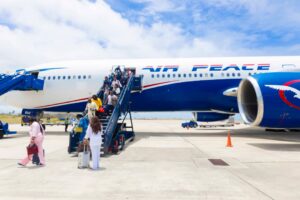

The ruling, delivered by Justice B.F.M. Nyako on June 29, establishes that the consumer watchdog acted squarely within its legal mandate under the Federal Competition and Consumer Protection Act (FCCPA) 2018 when it demanded information from Air Peace regarding allegations of exploitative domestic airfares.
The legal tussle dates back to January 2025, following a wave of public outrage over skyrocketing ticket prices across several domestic routes during the 2024 peak Christmas season.
In response to widespread consumer complaints, the FCCPC issued a Request for Information (RFI) to Air Peace to understand the metrics behind the sudden fare hikes.
Air Peace, however, pushed back legally. The carrier argued that the FCCPC lacked jurisdiction to probe airfare pricing unless the President of Nigeria had explicitly invoked the price-regulation provisions of the FCCPA.
Seeking to clip the Commission’s investigative wings, the airline approached the court for restraining orders.
Justice Nyako completely rejected the airline’s arguments, clarifying a critical distinction in economic regulation and noting that investigating a consumer complaint is fundamentally different from setting prices.
The court held that the FCCPC properly exercised its investigative powers under Sections 17, 32, and 33 of the FCCPA, and that requesting data as part of a fact-finding mission does not constitute price-fixing or price regulation under Sections 88, 89, and 90 of the Act and that the Commission did not order Air Peace to lower fares, impose a pricing formula, or declare the airline’s tariffs illegal; it merely sought clarity in response to consumer grievances.
Justice Nyako warned that adopting Air Peace’s interpretation would effectively paralyse the FCCPC, stripping it of its ability to look into any pricing-related consumer exploitation unless the President intervened. This, the judge noted, would defeat the legislature’s intent and undermine market oversight.
This judgment deals a consecutive legal blow to the airline on the same subject matter. Just months earlier, in April 2026, Justice James Omotosho similarly dismissed a separate suit by Air Peace challenging the FCCPC’s authority to issue summonses and investigate consumer complaints.
For Nigeria’s aviation sector, this second ruling solidifies the FCCPC’s role as an active referee. Airlines can no longer shield their pricing strategies under the guise of deregulation when a deluge of consumer complaints triggers an official inquiry.
Reacting to the judgment in a statement from the Director of Corporate Affairs, Ondaje Ijagwu, the Executive Vice Chairman/CEO of the FCCPC, Mr Tunji Bello, hailed the ruling as a victory for fair market practices.
“The Court has again affirmed an important principle,” Bello stated. “The FCCPC neither sought to fix nor regulate Air Peace’s fares. It simply exercised its lawful authority to obtain information as part of an investigation into a matter of legitimate consumer concern.”
Bello emphasised that an RFI is a standard fact-finding process, not an enforcement action or an assumption of guilt.
He reiterated that while the framework for actual price regulation remains distinct, the Commission’s mandate to investigate market exploitation remains absolute, transparent, and bound by the rule of law.
 With this judicial clarity, domestic airlines must now brace for a regulatory environment in which consumer protection laws have real teeth, and transparency in tariff structures will be heavily scrutinised.
Google+

It’s good to see the FCCPC’s authority being upheld in this case. This clarifies things for consumers regarding airline pricing.
Absolutely!