- FAAN MD: Financing talks for Lagos airport rail extension reach advanced stage
- Riding the Tidal Wave: How CITA Energies navigated 20 years of jet fuel volatility
- Delta unveils major upgrade to Delta One, redefines premium long-haul travel
- NSIB opens probe into Challenger 604 door separation incident
- Private jet forced into emergency landing in Abuja after door detaches



From Sirika’s Vision to Keyamo’s Delivery: A United Front for CAMP 2045

The ink is barely dry on the landmark 20-year Civil Aviation Master Plan (CAMP), officially handed over by the International Civil Aviation Organisation (ICAO) to Minister Festus Keyamo just yesterday in Marrakech.
For a sector that has long operated on emergency fixes rather than long-term blueprints, this document—spanning 2025 to 2045—is the most significant regulatory milestone since the 2022 Civil Aviation Act.


The handover of the CAMP marks the shift from planning to the much harder phase: execution. The grey area to watch is the implementation support. ICAO delivered the plan, but will they stay for the Implementation Support Mission?
Without a dedicated CAMP Delivery Unit that includes private-sector representatives, the plan risks being shelved, as with previous master plans.
The formal receipt of the 2025–2045 CAMP from ICAO is just the end of the beginning. The next logical step—and the one the industry is demanding—is a rigorous stakeholder evaluation and critique before the Ministry moves toward final adoption and codification.
One expects the Ministry to call a ‘Special Session’ or a ‘National Aviation Summit’ specifically to deconstruct the CAMP. Keyamo has already committed to gathering feedback from stakeholders and citizens alike to refine policies.
Before the CAMP becomes law, the Nigeria Civil Aviation Authority (NCAA) must ensure it doesn’t conflict with existing Nigerian Civil Aviation Regulations (Nig. CARs).
The NCAA has been reviewing its Policy and Procedure Manuals (PPM) as recently as April 13, 2026. A formal “Gap Analysis” will be conducted to see where the ICAO roadmap requires new legislative backing or changes to the 2022 Civil Aviation Act.
Kudos must be given to the immediate past Director-General of NCAA, Capt Musa Nuhu and his team, who started the process and paid $669,800 for the CAMP.
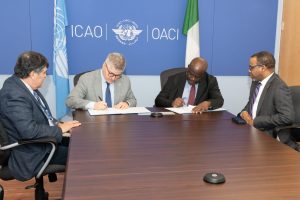
Nuhu and the ICAO Secretary-General, Mr Juan Carlos Salaazar, signed the agreement during the ex-DG’s visit to ICAO in Montreal, Canada, on June 22, 2023, before he was removed from office.
 Nuhu with Juan Carlos Salaazar
He said after signing the deal with ICAO, “The Masterplan, when implemented, will further unlock opportunities in the Nigerian aviation industry. This is a major step in repositioning the nation’s aviation industry to attain its full potential and make significant contributions to the nation’s economic growth and development.
All relevant stakeholders within and outside the aviation ecosystem will be involved in developing and implementing the CAMP.”
For his effort, he deserves a huge commendation and recognition for setting up the template for what has the potential to revolutionise the nation’s aviation ecosystem and significantly increase the nation’s Internally Generated Revenue (IGR).
Keyamo and the NCAA DG, Capt. Chris Najomo must also be praised for following up on the process in which the Minister officially received the CAMP.
But as a key observer of the aviation industry in Nigeria, a master plan is only as good as its first three years of execution.
Here is an analysis of what must happen next to ensure CAMP doesn’t become another high-level souvenir from a global symposium.
From Policy to Steel and Concrete
The CAMP outlines a vision for Aerotropolis hubs and infrastructure renewal. However, the immediate next step must be aligning the N987 billion 2025 infrastructure budget with these ICAO-vetted priorities.
We must move beyond terminal aesthetics and focus on the end-to-end capacity that experts have highlighted. This means ensuring that apron expansion at MMIA and the TRACON modernisation are integrated into the master plan’s long-term traffic forecasts, not just today’s congestion.
Solving the Human Capital Gap
A massive retooling of the Nigerian College of Aviation Technology (NCAT) is required. We should expect new partnerships with global bodies such as ICAO and the International Air Transport Association (IATA) to provide certified training for the next generation of aviation professionals, shifting away from ageing technical staff toward a digitally native workforce.
Keyamo highlighted the skills gap at the GISS 2026 summit, and he is right to do so. The next step is a formal audit of our technical personnel. We cannot build a 2045-ready industry on 1995-era training.
Local airlines will likely critique the CAMP if it focuses too heavily on infrastructure (FAAN’s domain) and not enough on the economic de-risking of the airline business. They will want to see the specific Cape Town Convention protections mentioned in the CAMP translated into lower insurance premiums—a core theme of the recent NAAIS summit.
Litmus test
Watch for the inter-agency coordination. The CAMP will fail if the NCAA, FAAN and the Nigerian Airspace Management Agency (NAMA) continue to work in silos. The true litmus test for Nigeria will be whether we can maintain policy continuity across multiple political administrations over the next 20 years.
Google+