- FAAN MD: Financing talks for Lagos airport rail extension reach advanced stage
- Riding the Tidal Wave: How CITA Energies navigated 20 years of jet fuel volatility
- Delta unveils major upgrade to Delta One, redefines premium long-haul travel
- NSIB opens probe into Challenger 604 door separation incident
- Private jet forced into emergency landing in Abuja after door detaches



Minister: Nigerian carriers can’t compete without financing, fuel-efficient aircraft

…Nation to grant conditional frequencies to foreign carriers
…Airlines subsidising inefficiency
Minister of Aviation and Aerospace Development, Festus Keyamo, said for decades, the government focused on saving airlines through bailouts or protective policies, but noted that the new focus is on ensuring they have the legal and financial infrastructure to save themselves.
This is coming as the Minister addressed the tension between inviting foreign airlines and protecting local ones.
He noted that the shift is toward reciprocity, stating that the government will no longer simply hand out frequencies to foreign carriers without ensuring that Nigerian airlines have the capacity to compete on those same routes.
He wants Nigerian carriers to stop being domestic-only and start capturing a larger share of the 25.7 million passengers projected for the Nigerian market by 2029.

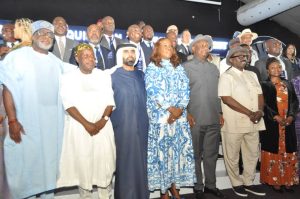
In his keynote at the Nigeria Aircraft Acquisition and Investment Summit (NAAIS) in Lagos, Keyamo defined this pivotal shift as a move from government-led intervention to market-driven sustainability.
This summit marks the first time the Federal Government has sat down with global lessors, the Central Bank of Nigeria (CBN), and local CEOs in one room to hammer out financing frameworks.
Keyamo’s pivotal shift is essentially an admission that operational efficiency and financing certainty are the only things that will stop the cycle of airline collapses in Nigeria.
The Minister stated that the government’s role is no longer to provide direct cash injections but to create bankable environments, stressing that without modern, fuel-efficient fleets and financial certainty, Nigerian airlines will find it extremely difficult to compete sustainably and urging them to scale up.
His statement underscores a hard truth: the era of managing older, fuel-heavy aircraft is over if Nigerian airlines want to survive the current global economic climate.
Keyamo argued that fuel typically accounts for 40% to 45% of operating costs for Nigerian airlines. He pointed out that international competitors are flying next-gen aircraft (like the Airbus A220 or Embraer E2) that consume significantly less fuel.
He further stated that without modern fleets, Nigerian airlines are essentially subsidising inefficiency, making it impossible to offer competitive fares or maintain healthy margins.
The Minister was very direct about why Nigerian airlines haven’t been able to scale, which he attributed to a trust deficit for Nigerian carriers, especially with lessors.
He highlighted that for years, Nigeria was blacklisted by global lessors due to the difficulty of repossessing aircraft when payments defaulted.
He noted that the recent full implementation of the Irrevocable Deregistration and Export Request Authorisation (IDERA) has finally given global lessors the legal certainty they need to do business in Nigeria.
The Minister linked this modernisation directly to the African Continental Free Trade Area (AfCFTA), warning that if Nigerian airlines don’t use this window of “financing certainty” to scale up now, they will be sidelined by other African mega-carriers already moving to capture the Nigerian market.
He said, “We are moving away from an era of ‘hand-to-mouth’ aviation. If you want to fly the Nigerian flag internationally, you cannot do it with 25-year-old planes and high-interest short-term loans. We are creating the bridge to long-term, single-digit global financing. Aircraft acquisition sits at the intersection of these three pillars of capital, confidence and capacity.”
“That is why this Summit is so critical. We are not merely discussing airplanes. We are designing a financing ecosystem. We are convening OEMs, lessors, banks, export-credit institutions, insurers, regulators and operators to move from fragmented conversations to structured transactions; we are aligning market demands with capital solutions.”
“We are building the conditions for fleet modernisation, dry-lease scale-up, local MRO development, aviation workforce expansion, and stronger route economics for Nigerian carriers. In essence, we are working to close the gap between Nigeria’s aviation potential and its realised aviation capacity”.
He called on the country’s global financiers, lessors, Original Equipment Manufacturers (OEMs), development partners, and institutional investors to assess the country’s readiness to partner with them, noting that the country has strengthened its aviation compliance architecture and improved creditor assurance.
Demonstrating progress in revenue repatriation, he said the government is supporting local MRO development, investing in digital and institutional reform, and pursuing cargo modernisation.

“Nigeria stands today at the threshold of a new aviation era, an era in which capital is more confident, institutions are more credible, and capacity is being deliberately built. Let us seize this moment together.”
