- Nigeria emerges Africa’s 4th largest aviation market, passenger traffic surges 11.9%
- Iyayi: Communication gaps, inadequate facilities behind airlines' delay crisis
- Part 2: Apologies for the Delay, Rethinking Culture of Late, Postponed, Cancelled Flights in Nigeria
- Enugu Air to launch regional route to Douala Sept 23
- SAA wins top African airline award at travel market



Arik incident: NSIB preliminary report details 23 wreckage impact on aircraft

- Highlights extensive damage to airplane
The Nigerian Safety Investigation Bureau (NSIB) has detailed the extensive damage to an Arik Air aircraft that occurred during the climb-out en route to Port Harcourt International Airport, Port Harcourt, on February 11, 2026, in its preliminary report.
On 11 February 2026, a Boeing 737-700 aircraft with nationality and registration marks 5N- MJF, operated by Arik Air Limited, was on a scheduled passenger flight from Murtala Muhammed International Airport (DNMM), Lagos, to Obafemi Jeremiah Awolowo International Airport (DNPO), Port Harcourt.

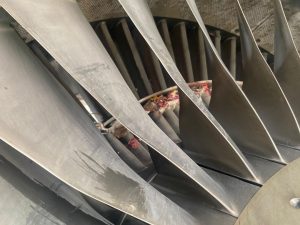
The report details a significant mid-air engine failure that forced the flight, which was en route from Lagos to Port Harcourt with 80 passengers and 7 crew members, to divert to Benin Airport.
The report highlights that the incident, which occurred at an altitude of approximately 26,000 feet while en route from Lagos to Port Harcourt, resulted in at least 23 separate wreckage impacts on the aircraft. It is also based on factual information from the flight crew, air traffic control transcripts, and flight data recorders (FDR/CVR).
All other 23 fan blades were found to be chipped or damaged. The engine inlet cowling was missing entirely. One fan blade (number 6) was broken off at the root, while the remaining 23 fan blades were all found to be chipped or damaged.
The inboard and outboard engine cowling covers were folded upward, exposing internal engine accessories.
According to the report, an engine-driven pump (EDP) clamp was found loose, and a deep cut of approximately 0.6 inches was noted on the airframe.
The report confirms that the crew heard a “loud bang” followed by abnormal engine indications at cruising altitude, leading to a precautionary engine shutdown and an emergency diversion.
All 80 passengers and 7 crew members, according to the accident investigative body, disembarked safely in Benin.

It noted that it is conducting further technical examinations of the broken fan blade and engine components to determine if the failure was caused by a bird strike, foreign object debris (FOD), or mechanical fatigue.
Google+